Showing posts with label Pharaoh. Show all posts

Monday, August 6, 2018

Ancient Egypt August 6 2018


Grand Egyptian Museum receives head of King Senusert I
King Senusret head - Ministry of Antiquites Offical Facebook Page

The Grand Egyptian Museum (GEM) received on Friday the red granite head of the statue of King Senusret I from an antiquities' storehouse in Cairo Citadel in order to be displayed with the opening of the museum in 2019.

In a statement, GEM general supervisor Tareq Tawfiq said the head is carved from red granite and has the common artistic features found in pieces attributed to the Middle Kingdom.

Incredible Electromagnetic Discovery In Great Pyramid Of Giza's Hidden Chambers
Dog enjoying the electronimagnetic energy of the Great Pyramid. © Michalea Moore 2017

The Great Pyramid of Giza is steeped in history and mythology, and as such fascinates researchers from various fields who all want to unravel its many secrets.

Now, an international team of physicists has found that, under the right conditions, the Great Pyramid can concentrate electromagnetic energy in its internal chambers and under its base.

Two Ancient Egyptian tombs uncovered in Minya

The Egyptian-Australian Archaeological Mission of the University of Macquarie, Australia have rediscovered the tombs of two statesmen from the Middle Kingdom of Egypt at the Beni Hassan antiquities area in Minya, Secretary General of the Supreme Council of Antiquities Mostafa al-Waziry announced.

Ancient Egypt: A Tale of Human Sacrifice?
Subsidiary chambers of the tomb of King Den. Photos by the authors
From our modern perspective, the idea of human sacrifice in ancient Egypt is so exotic as to be desirable. But what evidence would really indicate the practice in ancient Egypt? Is it to be found in the pathology of buried individuals, the architecture, the iconographical record, or in oral and written tradition? Are other interpretations equally if not more valid? Our discussion focuses on the early sites of Adaima, Hierakonpolis, Abydos, and Maadi.

Adaima lies about 550km south of Cairo and was primarily excavated between 1989 and 2005. Its two cemeteries contain almost 900 Predynastic graves studied by osteoarchaeologists and anthropobiologists. Some skeletons showed clear cut marks on the upper vertebrae and it seems that skulls were removed after decomposition. But does this constitute human sacrifice?

How Ancient Egypt Shaped Our Idea of Beauty
These cosmetic pots contained kohl, which the ancient Egyptians applied like eye-liner, perhaps to screen out the sun (Credit: Two Temple Place/Ipswich Museum)

Walking around Beyond Beauty, the new exhibition organised by charitable foundation the Bulldog Trust in the neo-Gothic mansion of Two Temple Place in central London, you would be forgiven for thinking that the ancient Egyptians were insufferably vain.

Jean-Claude Golvin Online
ÉGYPTE - OUADI ES SEBOUA - TEMPLE DE RAMSÈS II
Jean-Claude Golvin is a French architect, archaeologist and former researcher at the CNRS (National Center for Scientific Research - Bordeaux III Michel de Montaigne University). He is the world’s first specialist in the visual reconstruction of great sites from the Antiquity.

He has produced over 1000 drawings of ancient and medieval cities and monuments, most of which are deposited at the Departmental Museum of Ancient Arles – the most active museum in France regarding this period in history, second only to the Louvre.

Here is the direct link to the Egypt page.

Where's the Tomb of King Tut's Wife? Valley of the Kings Dig Leaves Mystery

Before ancient Egyptians constructed a tomb they would dig holes that contained buried artifacts. The tomb would then be built nearby. Recently, in the Valley of the Kings (where King Tut was buried), archaeologists unearthed a set of these "foundation deposits," but to their puzzlement, no tomb has been found.

Women Archaeologists Database!
Image: Margaret Murray and Hilda Petrie

"Breaking Ground may as well have been titled 'Against All Odds,' as the women archaeologists whose lives and careers we remember here faced innumerable challenges and difficulties but prevailed to contribute significantly to the expansion of our knowledge of the ancient world."

Explore this database of the intrepid women of archaeology by Brown University.


Picture of the week: Abu Simbel 1930

Abu Simbel Temples in 1930 before the transfer of The Abu Simbel temples. Known as the "Temple of Ramesses, beloved by Amun" it was one of six rock temples. The smaller temple is dedicated to the goddess Hathor.


It was relocated in its entirety in 1968, because it would have been submerged during the creation of Lake Nasser after the building of the Aswan high dam on the Nile River.


Monday, June 25, 2018

Ancient Egypt June 25


See you later, sphinx
Visitors to the Penn Museum explore the Egypt Gallery and its centerpiece, the Sphinx of Rameses II, the sixth-largest granite sphinx in the world, and the largest in the Western Hemisphere. Photo by Lauren Hansen-Flaschen. 

The colossal stone creature will be going under wraps for conservation at the Penn Museum.

For the first time in 105 years, the Penn Museum’s sphinx will be taken out of public view for an extended period of time. Starting on July 9, the colossal stone creature will be under wraps for an estimated four to six years while artifacts in the Egypt galleries undergo conservation and the spaces undergo a major renovation.

From the Pharaohs to Cleopatra and Julius Caesar: how Egypt influenced Greece and RomeUnknown artist. Antinous as Osiris, about 130. Roman, marble. (Musee du Louvre/RMN-Grand Palais/Daniel Lebee/Carine Deambrosis/Art Resource)

Big, needlelike sculptures, based on Egyptian prototypes, are dotted all over America. The most famous, obviously, is the Washington Monument. Another, in Boston, commemorates the battle of Bunker Hill. There’s even an authentic, 3,000-year-old Egyptian one in New York’s Central Park, known as “Cleopatra’s Needle.”

Solstice at Karnak Temple’s Western Gate  
The sight of the sun falling perpendicular on the temple of Amoun Ra’ in Luxor - Archive

he sun will set from the western gate of the Karnak Temple on June 21, which marks the rare astronomical phenomenon of summer solstice.

Ahmed Abdelkader, a researcher specialized in astronomical tourism, told MENA that sun rays will disappear gradually from the temple’s complex starting 6 p.m.until the Holy of Holies is darkened.


Paul McCartney's 'Egypt Station': What Is It?

Paul McCartney’s upcoming project is titled “Egypt Station,” he’s finally made clear – but fans continue to speculate on what form it might take.

While the Beatles icon had previously said he was planning to release an album in 2018 – and last week unveiled a new track, "Come On to Me," in concert that presumably appears on it – he hasn’t yet said whether that’s what “Egypt Station” is.

Down the Nile, into the Mediterranean
“Hippopotamus” (2nd century), artist unknown. Roman. Rosso antico. Ny Carlsberg Glyptotek, Copenhagen. Photo by Ole Haupt

Because of its scope and depth, it’s best to have an initial understanding of what “Beyond the Nile: Egypt and the Classical World” has set out to achieve. “The overarching goal of this exhibition,” notes Jeffrey Spier, “is for visitors to understand Egypt, Greece, and Rome not as monolithic, separate entities but as cultures that shared and exchanged aspects of their religion, artistic traditions, languages, and customs in an evolving milieu.”

Death of the Firstborn Egyptians


Death of the Firstborn Egyptians from Nina Paley on Vimeo.

Monday, January 29, 2018

Ancient Egypt January 29


The Top 10 Secrets of The Temple of Dendur at NYC’s Met Museum
Reconstruction of Temple of Dendur’s possible paint. Image via Met Museum.
The Metropolitan Museum of Art, with its many secrets, houses a wonderful collection of works that date back to ancient times through the Renaissance. Most notably though, the museum is home to a bona fide Egyptian temple!

The Temple of Dendur, as it’s called, is completely open to the public, which means visitors can walk through its doors and hallways, experiencing the temple as it was originally used. Here are 10 of our favorite fun facts about the structure.


Opera Aida Is Coming To The Pyramids But It’ll Literally Cost You A Fortune

Opera Aida is set to be performed in Egypt alongside at Pyramids of Giza stage on the 8th, 9th, and 10th of March. The show is welcoming an audience of 1500 people; this will be the second time it’s played outside the Opera House, the first being played at the Karnak Temple in Luxor in 1987. The audience should expect an entirely different setting and design than any other!

THE MISADVENTURES OF WENAMUN

"This comic is easily the best retelling of an ancient Egyptian story I've ever seen."

--T.G. Wilfong, Professor of Egyptology, Kelsey Museum of Archaeology, University of Michigan
Drawing on one of the earliest literary travel accounts known to man, travel writer Rolf Potts and illustrator Cedar Van Tassel recreate the comic tale of Wenamun, an ancient Egyptian priest whose overseas voyage in search of Lebanese timber resulted in an ongoing series of fiascos.

Unearthing Hatshepsut, Egypt's Most Powerful Female Pharaoh
Lepsius 1843–45. The Metropolitan Museum of Art, New York, Rogers Fund, 1929 

Before the British scholar Terence Gray adopted the name Wei Wu Wei and began his studies in Taoism, he was a budding Egyptologist with an iconoclastic streak. In 1920, seemingly tired of history as it had hitherto been written, he published a biographic study of the Egyptian queen and pharaoh Hatshepsut written not as a dry academic tract, but as a drama.

Nefertiti was no pharaoh, says renowned Egyptologist
The bust of Nefertiti from the Ägyptisches Museum Berlin collection, presently in the Neues Museum.

Contrary to popular opinion, one of the most famous women in ancient history did not rule Egypt, according to a new book.

Dr. Joyce Tyldesley, an Egyptologist from The University of Manchester, says Queen Nefertiti was just one of a series of powerful queens who played an influential role in Egyptian history.

It was, argues Dr. Tyldesley, the beauty of her famous limestone and plaster sculpture—reportedly Hitler's favourite piece of ancient art—which propelled her into the public spotlight after it was put on public display in 1923.

Top Facts about King Ay
Ay receiving the Gold of Honor – Photo Courtesy of Wikipedia

Several secrets around Ancient Egypt and its rulers have not yet been revealed; the magical Egyptian deserts still carry a lot underneath their sands.

Ministry of Antiquities announced that famous Egyptologist, author and former Minister of Antiquties Zahi Hawas will lead an archaeological mission to begin new excavation works at Valley of the Monkeys, located at Valley of the Kings, according to a statement released on the Ministry of Antiquities official Facebook page.

How climate change and population growth threaten Egypt’s ancient treasures
Roger Anis for UN Environment

In his 40-something years as an archaeological excavator on Luxor’s West Bank, Mustafa Al-Nubi has witnessed a flurry of changes.

Tourist numbers have surged, fallen, and then slowly grown again. Local villages have exploded in size. Even the landscape has undergone a radical transformation, as Egyptologists slowly pick their way through the vast Theban Necropolis. “It’s like one big museum now,” Nubi says. “My grandfather would not recognize his own house.”

Researchers use non-visible imaging approach to reveal climate change and population growth threaten Egypt’s ancient treasures

An international team lead by University College London (UCL) researchers has developed a non-destructive multimodal imaging technique that utilizes multispectral imaging and a range of other imaging methods to reveal text from ancient Egyptian mummy cases for research and analysis.

Hidden Ancient Egyptian Paintings Revealed Thanks To New Digital Imaging Tool

Scientists have used a new imaging technique to re-examine Egyptian art and find details that were previously missing.

Linda Evans and Anna-Latifa Mourad from Macquarie University in Sydney, Australia describe in their paper in the Journal of Archaeological Science how they used a technique called DStretch to analyze the ancient paintings. These paintings were found at Beni Hassan, an ancient Egyptian cemetery that’s located near to the city of Minya in modern Egypt.

The Earliest Music in Ancient Egypt video

This video supplements Heidi Köpp-Junk's article, "The Earliest Music in Ancient Egypt," featured in The Ancient Near East Today. Visit http://asorblog.org/2018/01/16/earlie... to read the article.


Ancient Egyptian Humor Video


Horrible Histories - Egyptian Gods and The Devourer - YouTube from Ellen Warburton on Vimeo.

Pictures of the Week

Moving the statue of Ramses II to the Grand Egyptian Museum.


Monday, January 15, 2018

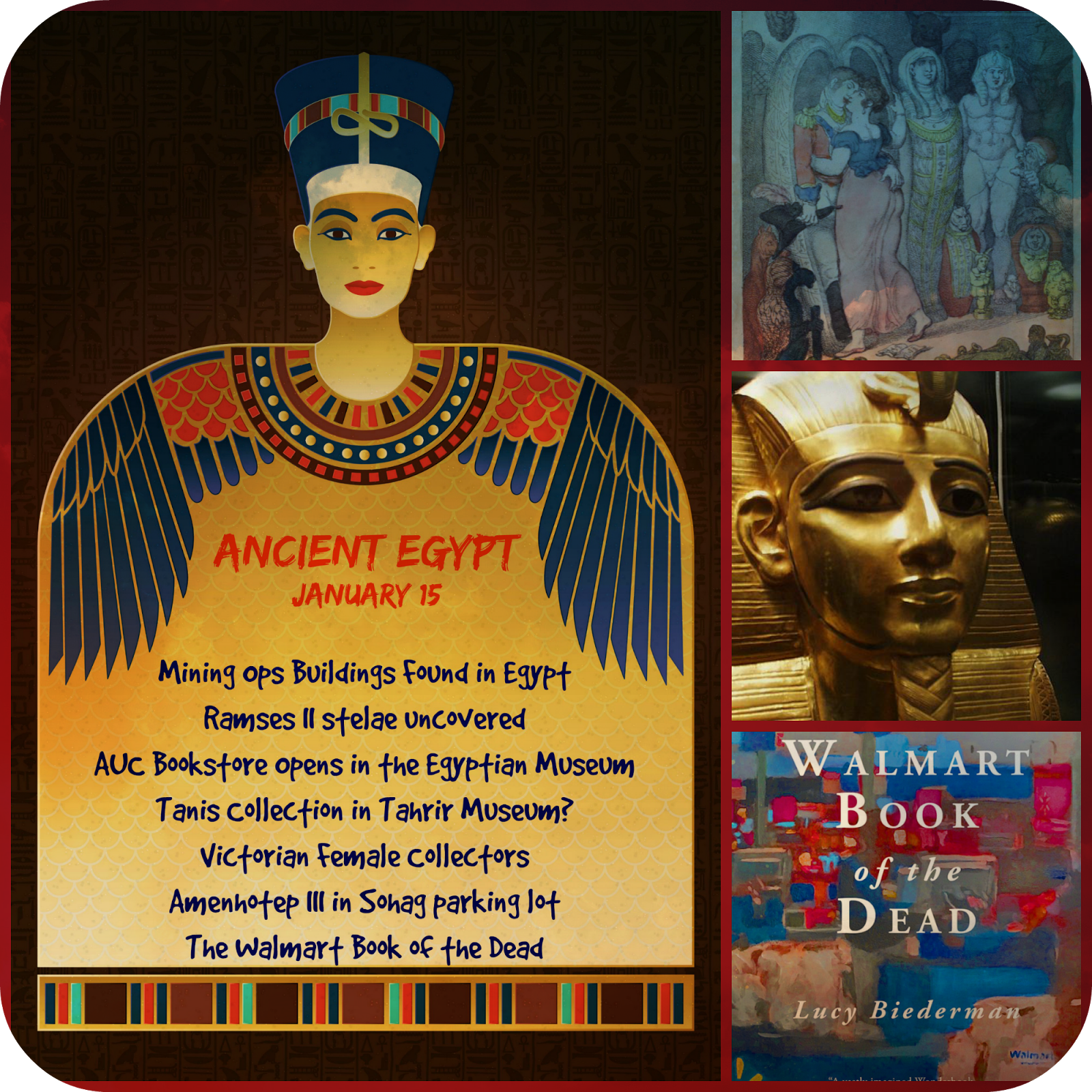
Ancient Egypt January 15


Ancient mining ops buildings found in Egypt — ministry
(AFP photo)

The ruins of two buildings used to supervise mines in ancient Egypt more than 4,400 years ago have been discovered in the south, the antiquities ministry said on Thursday.

The find was made by a US-Egyptian mission in the Tal Edfu area north of the city of Aswan.

Ramses II stelae uncovered at San Al-Hagar site

San Al-Hagar is a very distinguished archaeological site houses a vast collection of temples, among them temples dedicated to the goddess Mut, god Horus and god Amun.

During work carried out at San Al-Hagar archaeological site in Sharqiya governorate with a view to develop the site into an open-air museum, archaeologists stumbled upon a stelae of 19th Dynasty King Ramses II.


AUC Bookstore Opens in the Egyptian Museum in Cairo

The American University in Cairo Press (AUC Press) recently opened a bookstore in The Egyptian Museum, as part of the Egyptian Heritage Exhibition, marking the 115th anniversary of the Museum. “AUC Press and Bookstores regularly take part in events and book fairs but this is a unique and excellent initiative by the Ministry of Antiquities,” said Nigel-Fletcher Jones, director of AUC Press and Bookstores. “Many visitors to Cairo are here on a short, almost whistle stop tour, so this may be one of a few rare moments when they are able to see the huge range of high quality books AUC Press has to offer.”


Will the Tanis Collection replace King Tut’s in the Tahrir Museum?
Note: I was looking for the mask to which they refer, but there are apparently several gold masks in the Tanis Collection. I chose the mask of Funeral mask of Psusennes 1 1, around 994 BCE. 48 cm high. Room 2, 1st Floor from this page.
“The Egyptian Musem in Tahrir will not die, it will continue to receive visitors all year round,” stated Khaled el-Enani, Minister of State for Antiquities, proudly, on more than one occasion. Even now that King Tutankhamun, hereafter referred to as Tut, has been transferred to the Grand Egyptian Museum, the Egyptian Museum in Tahrir still has the Yuya and Tjuyu collection, in addition to the Tanis gold collection which includes a gold mask that could potentially replace King Tut’s mask in the exhibition.

The Victorian female collectors captivated by Ancient Egypt
Thomas Rowlandson Modern Antiquities (hand coloured engraving, c. 1800). Nelson and Lady Hamilton canoodle in an Egyptian coffin, hungrily watched by her antiquarian husband Sir William Hamilton.

In Victorian Britain’s overwhelmingly masculine society, intelligent, driven and often moneyed women were obliged to restrict their energies to acceptable “feminine” activities; like travelling, writing, fund-raising – and amassing impressive collections of Egyptian antiquities.

The results of this male-sanctioned pursuit are said to have greatly helped to establish British Egyptology and boosted the Victorian interest in all things Pharaonic.

Fragment of Black granite statue of King Amenhotep III discovered in Sohag parking lot

The Ministry of Antiquities announced the discovery of an artifact in a parking lot in Akhmim, Sohag governorate, during a drilling operation to develop the site.

The Walmart Book of the Dead

As for who reads this book
And who follows its spells
I know your name
You will not die after your death
In Walmart
You will not perish forever
For I know your name

So begins this darkly comic incantation on the gods and scourges of the 21st century. The Walmart Book of the Dead was inspired by the ancient Egyptian Book of the Dead, funerary texts with accompanying illustrations containing spells to preserve the spirit of the deceased in the afterlife. In Lucy Biederman’s version, shoplifters, grifters, drifters, and hustlers, desirous children, greeters, would-be Marxists, wolves, and circuit court judges, wander Walmart unknowingly consigned to their afterlives.

“This BOOK is for the dark hours, the seam that ties the end of the evening to sunrise, when the bad, wrong things people do in and around Walmart are a hospital infection, red Rit dye in a load of whites, a gun in a classroom: by the time the problem is identified, it’s already ruined everything.”

 So, of course, you'll want to read ‘The Walmart Book of the Dead’‘The Walmart Book of the Dead’ review.

Monday, January 1, 2018

Ancient Egypt January 1, 2018


Giza 2000 BC


Celebrating the Seasons: the Ancient Egyptian Calendar

In the spirit of the holidays, the Nile Scribes have teamed up with The Dead Speak Online to bring you a double feature on the celebration of holidays, or festivals, in ancient Egypt and their place in the Egyptian calendar.

A year of many discoveries

Coincidence has always played a major role in making new discoveries. Among the most famous examples are the uncovering of the tomb of the boy-king Tutankhamun on the west bank of the Nile at Luxor, the funerary collection of the Pharaoh Khufu’s mother Hetepheres, the Pyramids Builders’ Cemetery on the Giza Plateau, and the Valley of the Golden Mummies in the Bahareya Oasis.

This year, coincidence led to the discovery of more than 30 treasures, something which made the Ministry of Antiquities describe 2017 as “the year of discoveries”.

Today’s archaeologists are putting down shovels and turning to tech

In 1817, the Italian archaeology pioneer Captain Giovanni Battista Caviglia set out to explore the Great Pyramid of Giza, a.k.a. Cheops’ Pyramid: the oldest of the three three Giza pyramids and the most ancient of the Seven Wonders of the World. Like a lot of Egyptologists of his age, Caviglia’s pioneering work led to some profound insights into Ancient Egyptian civilization — but at a cost. Believing there was treasure located in an undiscovered hidden chamber in the pyramid, he used dynamite to blast several holes, causing significant damage.

Jump forward 200 years to 2017.

Mummies take centre stage in British Museum shake-up

The British Museum’s famous Egyptian mummies are to be moved as part of a historic overhaul of the institution’s permanent collection.  The mummies are set to be lowered to the museum’s ground floor — reuniting them with other Egyptian treasures, including the Rosetta Stone — under plans to display exhibits in chronological order for the first time.


Egypt's Heliopolis: Archaeologists face modern problems at ancient site

Excavating the ancient city of Egypt's Heliopolis is not your stereotypical dig. At one archaeological site, workers had to remove trash that had been 13-metres deep before they could start on the dirt. For the archaeologists and antiquities officials, the most pressing challenges are modern, not ancient.

Copper Content of Ancient Egyptian Ink May Help Us (Literally) Piece Together Egyptian History

Modern pen and paper has an ancient ancestor – ink and papyrus. Around 5,000 years ago, ancient Egyptians invented arguably one of the most important tools of civilized life, and their technology allowed people to communicate across vast distances for the first time. They cleverly harnessed the soot produced from the manufacturing of copper-containing ores to create the black ink color. Naturally, this idea quickly spread around the world to places like ancient Greece and Rome, which changed the world forever.

Ancient Deir el-Medina artworks exhibited in Cairo

A temporary exhibition showing artworks from the ancient Deir el-Medina kicked off here on Thursday. Deir el-Medina was home to a community of workers and artisans in charge of digging and decorating the tombs of Pharaohs in the ancient Egyptian New Kingdom period (16th century BC-11th century BC). (Xinhua/Ahmed Gomaa)

The Alchemy and Artistry of Ancient Egypt’s Funerary Portraits

HER RAPT, BLACK EYES GAZE out, as if she’s waiting for you to ask her a question. Her hairstyle—a braid twirled and tucked at the crown of her head—hints at a noble rank, as does her purple tunic, dangling earrings, and stack of necklaces dappled with pearls and gemstones. It’s been a few millennia, so flecks of paint have sloughed off of the lifelike portrait, which was fastened to her mummified body during Egypt’s Coptic period, nearly 2,000 years ago.


Cleopatra Biopic Will Be a ‘Dirty, Bloody’ Political Thriller

Screenwriter David Scarpa says Sony’s in-the-works Cleopatra will be a “dirty, bloody” political thriller. Denis Villeneuve is in talks to direct the historical biopic based on Stacy Schiff’s 2010 book Cleopatra: A Life. Angelina Jolie has long been attached to the project, but it’s unknown whether she remains on-board.

For more info, see Villeneuve’s “Cleopatra” Has Swearing & Sex.

The Cleopatras

The Cleopatras was a 1983 BBC Television eight-part historical drama serial. Written by Philip Mackie, it is set in Ancient Egypt during the latter part of the Ptolemaic Dynasty with an emphasis on the Cleopatras. Intended to be the I, Claudius of the 1980s, The Cleopatras met with a decidedly mixed critical reaction. It was regarded and portrayed as a gaudy farce.


The 10 Biggest Archaeology Discoveries of 2017
Photo Credit: Egyptian Ministry of Antiquities

Of particular note to Egyptophiles, Slides 6 & 7, although to be perfectly clear, these are all pretty cool.

Archaeologists were digging up plenty of fascinating bones and other ancient remains throughout 2017, revealing more intriguing information about humans' past. From hundreds of mysterious stone structures in Saudi Arabia called gates, to a previously undiscovered cave that held Dead Sea Scrolls, to a woman who was literally buried with her husband's heart, Live Science takes a look at 10 of the coolest archaeological and historical finds of the year.


RAIDERS OF THE LOST ART

A pristine, white sarcophagus once held the mummy of the Egyptian Pharoah Seti I, whose father, Ramses, was the revered ruler of the ancient Egyptian kingdom for more than a decade sometime in the 1200s B.C. The sarcophagus located in a tomb chamber decorated with some of the most well-preserved hieroglyphs and paintings of Egyptian mythology known to man. After centuries of mass pillaging—and the mass tourism of more recent years—the tomb has been irreversibly destroyed.

But the Egyptian artifact has been granted a second life at the Antikenmuseum in Basel, Switzerland, as a 3-D printed copy.

Monday, December 11, 2017

Ancient Egypt December 11


A portrait head of Ptolemy VIII

Literary sources describe Ptolemy VIII of Egypt as a terrible man who enjoyed a lavish lifestyle,’ says Max G. Bernheimer, International Head of Antiquities at Christie’s. Grotesquely overweight, he was given the nickname Physkon, which roughly translates as ‘pot-bellied’, or ‘fatty’, explains the specialist.

The studio behind Firewatch heads to Egypt for its new game

Tonight at the awards ceremony/marketing bonanza known as The Game Awards, Campo Santo, the studio behind the acclaimed first-person adventure Firewatch, unveiled its next project. Titled In The Valley Of Gods, it’ll put players in the shoes of a filmmaker who heads to an ancient Egyptian valley with their partner in search of fame and fortune during the 1920s, which happens to coincide with the discovery of King Tut’s tomb and the widespread fascination with Egyptian culture that followed.

Mummies discovered in Elephantine tombs date to Late Period of ancient Egypt

Scans and 3D X-rays on two mummies which were discovered during excavations at the Elephantine tombs, west of Aswan, revealed the mummies date back to the Late Period of ancient Egypt.

Ancient Egyptian cuisine
Photo Courtesy: Andreas Praefcke

Even today, Ancient Egyptians captivate the minds of people around the globe because of their extraordinary contributions to civilization. Egypt Today presents the top facts about Ancient Egyptian cuisine.

Ancient Egypt in pictures

As an elementary school teacher for more than 25 years, George Neeb has given a lot of lessons about ancient Egypt.

There's something about the land of pharaohs that captures the imagination.

But, while he delivered the Grade 4 curriculum covering early societies, Neeb was struck by the lack of historical fiction picture books on the subject. So, he decided to create one of his own.

He's hoping Pharoah's Arrow, which he wrote and illustrated, will become a teaching tool for others.

Stunning 3,000-year-old Egyptian gate . . .

moved from Cairo to the pyramids of Giza to be displayed alongside Tutankhamun's tomb

The gate is made from pink granite and was made in the rule of Amenemhat I
It will undergo restoration and be put on display in the Grand Egyptian Museum
The gate will join thousands of artefacts due to be displayed at the museum
The museum is now scheduled to open partially in 2018

The Temple of Sethos at Abydos Mummication Museum Lecture

It was great to be back at the Mummification Museum for a lecture. There is another on Thursday at 7pm Dr Francisco Martin-Valentine talking about Amen-hotep, Huy Tomb AT 28. And another on Sunday at 5pm subject to be announced.

Tonight’s lecture was live streamed on Facebook by Moamen Saad if you check his Facebook page https://www.facebook.com/moamen.sca you will find it.

The Purpose of Art in Ancient Egypt. Part I and Part II.

The image in Ancient Egypt had a power in itself.
Why? Because in addition to evoking a reality, they made it arise. In Ancient Egypt everything that was depicted was also happening.


Sphinx head from "Ten Commandments" movie set found buried in California sand

1923 film "The Ten Commandments"  WARNER BROS. 

In 1956, Charlton Heston made Hollywood history by playing Moses in Cecil B. DeMille's "The Ten Commandments." DeMille's first take on the biblical tale happened 33 years earlier when he released a silent version of the story of the Hebrew exodus from Egypt.

Statues of ancient Egyptian lioness deity Sekhmet uncovered in Luxor

A collection of 27 fragmented statues of the lioness goddess Sekhmet has been uncovered during excavation work at the King Amenhotep III funerary temple at the Kom El-Hettan area on Luxor’s west bank.

Cat lover? US museum explores the power of felines in Ancient Egypt

Thousands of years ago, cats successfully managed to wrap us around their little paws. Nowhere is this clearer than in Ancient Egyptian art and culture, from paintings of felines to mummified cats buried with their masters’ remains.

SECRETS OF ANCIENT EGYPTIAN WRITING REVEALED IN 2,000-YEAR-OLD PAPYRUS SCROLLS

The black inks that ancient Egyptians used for writing on papyrus texts were made, in part, of metal. A collaboration of international researchers revealed for the first time that despite having their origins vary across time and space, ancient Egyptian papyri contained ink that shared a literal common element: copper.

Treasures From King Tut’s Tomb Are Going on a Blockbuster World Tour
Photo by Harry Burton, courtesy of INTERFOTO/Alamy Stock Photo

King Tut is hitting the road. As the 100th anniversary of the discovery of the tomb of Tutankhamun approaches, artifacts from the legendary site are heading on a 10-city international tour. The boy king’s final resting place, undisturbed and completely intact, was discovered by English archaeologist Howard Carter on November 4, 1922, its golden treasures igniting the imaginations of people around the world.


Unlocking the 'Lost City of the Pyramids,' and other Giza mysteries

The pyramids of Giza are loathe to give up their secrets. Over 4,000 years since they were constructed in Egypt's Old Kingdom, archaeologists are still uncovering fresh mysteries from this ancient and beguiling site.