Showing posts with label book reviews. Show all posts

Monday, October 7, 2019

Ancient Egypt News 10/07/2019

List of article for the post


Canterbury’s Egyptian-style Emulation Hall.
Emulation Hall: Egypt Style for Sale in Canterbury at Old Masonic Hall
Ian CurrieSource:News Limited

A former Masonic temple that wouldn’t look out of place on the streets of Cairo is for sale in Melbourne’s leafy east.

The 1927-28 Emulation Hall is sure to catch buyers’ eyes, being decked out in Egyptian motifs including gold-winged scarab beetles, sacred serpents, astrological symbols, lotus flowers, winged discs and “the eye of Horus”.

This “rare and distinctive” Egyptian Revival style saved the Canterbury curiosity from imminent demolition in 2012, earning it heritage status for being of architectural, historical and aesthetic significance to Victoria, according to the Heritage Database.

Crédit Agricole d'Egypte 1 Share of 4 Egyptian Pounds, 1951
Hieroglyphs in Scripophily Deciphered !
Crédit Agricole d'Egypte 1 Share of 4 Egyptian Pounds, 1951 

Antique securities from companies that operated in Egypt were typically illustrated with pharaonic themes and hieroglyphs. Standing on their own as true pieces of artwork, their mysterious designs made possible investors dream of promising outcomes. People bought these share certificates in the 19th and 20th century when the stock exchanges of Alexandria and Cairo flourished. But are the hieroglyphs on these certificates actually legible?

Book cover for The Ancient Egyptian Book of the Moon
New Books in Egyptology (July-August 2019)

Every two months the Nile Scribes update our readers on the most recent Egyptological publications. From popular reads to peer-reviewed scholarship, we hope to illustrate the wide variety of topics discussed in Egyptology, and perhaps introduce you to your next read! Below are 10 books that were released this summer (July and August).

  • Writing, Violence, and the Military: Images of Literacy in Eighteenth Dynasty Egypt (1550-1295 BCE)
  • Greco-Roman Cities at the Crossroads of Cultures: The 20th Anniversary of Polish-Egyptian Conservation Mission Marina el-Alamein
  • Perfekt, Pseudopartizip, Stativ: Die afroasiatische Suffixkonjugation in sprachvergleichender Perspektive
  • Le temple de Ptah à Karnak III
  • The Egyptian Collection at Norwich Castle Museum: Catalogue and Essays 
  • The Ancient Egyptian Book of the Moon: Coffin Texts Spells 154–160
  • New Horizons: The Pan-Grave ceramic tradition in context
  • Stone Tools in the Ancient Near East and Egypt
  • The Tekenu and Ancient Egyptian Funerary Ritual
  • The naos of Amasis: A monument for the reawakening of Osiris


Sailboat and balloon; the Nile River at Luxor
Several Missions Launched for the New Archaeological Season in Luxor

The new archaeological season has begun, showing promise in Luxor, the capital of world tourism. There are currently five archaeological missions, including three Egyptian missions, one Spanish, and one American conducting excavations there. Several new mission and

projects have been approved for the new season.
Luxor is known for its rich tombs and pharaonic temples, which all seem like they will see a strong tourist season.

Anubis painted blue
An Eerie Egyptian Burial Found With Nonsense Hieroglyphs on The Coffin
J. Dąbrowski/Polish Centre of Mediterranean Archaeology

Note: What the Petrie Museum had to say about this article on their 'unofficial' Facebook page: The discovery of this cemetery is very interesting, but nonsense hieroglyphs really aren't unusual despite the way this is reported. There are many examples during mature Egyptian dynasties, and this burial is from the Graeco-Roman period. The use of blue is also interesting as black would have been a much more accessible ('cheaper') colour, so maybe not quite such a non-elite burial.

When ancient burials are discovered in the sands of Egypt, the stories we hear are usually similar. High-ranking officials and nobles buried with rich grave goods, elaborate coffins, and often cartouches naming the deceased, so we know who they were. But a recent discovery paints a rather different picture.

Archaeologists have found dozens of 2,000-year-old burials near the necropolis of Saqqara that are much more minimal, even clumsy. Perhaps this is the resting place for people from the working or middle class, rather than the elite.

Ruins of Ptolemy IV Temple Unearthed in Sohag

The ruins of a temple belonging to King Ptolemy IV have been unearthed during an excavation at Kom Shaqao, Sohag by a mission from the Antiquities Ministry.

Parts of the ruins had been discovered by chance during the supplying of sewage lines in the city of Tama, Sohag early in September.

The Secretary General of the Supreme Council of Antiquities Mostafa al-Waziry said in a statement on the ministry’s official Facebook page that the sewage work was immediately stopped by a task team from the Ministry of Antiquities, assigned to conduct archaeological excavations in the area.
Doom of Egypt slots game
An Unforgettable Trip at Online Casinos With Doom Of Egypt

Pack your bags for a memorable trip to ancient Egypt by Play ‘n Go which is the best to bring you on this Egyptian adventure. Doom of Egypt is a combination of several Ancient Egyptian themed slots produced by Play’ n GO throughout the years. The amazing theme is among the most well-known in the world of online slots. Ancient Egypt portrays a time of exuberance, of astonishing riches and hidden treasures. They have successfully given us Egypt-themed slots like Leprechaun Goes Egypt, Legacy of Egypt and, of course, the biggest hit and the all-time favorite Book of Dead.

Coffin of Middle Kingdom Princess Hatshepset
Archaeologists Reveal the Face of an Egyptian Princess

Archaeologists have revealed the face of an Egyptian princess who lived almost 4,000 years ago by painstakingly piecing together the wooden shards of her sarcophagus.

The fragments expose the likeness of a royal, possibly Princess Hatshepset, daughter of Pharoah Ameny Qemau, who lived towards the end of Egypt's Middle Kingdom.

Her image will be seen for the first time on Channel 4's Egypt's Lost Pyramid programme, which follows the two-year excavation and study of the royal's final resting place.

Ram-headed sphinx dates to the time of Amenhotep III
Amazing Ram-Headed Sphinx Linked to King Tut’s Grandfather Discovered in Egypt
Robert Mittelstaedt/Gebel el Silsila Project

Archaeologists in Egypt have discovered a large ram-headed sphinx that is linked to King Tutankhamun’s grandfather.

The sphinx, which is 16.4-feet long, 11.5-feet high and 5-feet wide, was found beneath several feet of debris at Gebel-el-Silsila, an ancient quarry on the Nile. Only its head was visible prior to excavation.

The sculpture is believed to be from the time of King Tut’s grandfather, the pharaoh Amenhotep III, who ruled in the 14th century B.C.

Unpacking 19th Dynasty Coffin (video)

The unpacking of the 19th Dynasty coffin of Sennedjem upon arrival at the National museum of Egyptian Civilization.(NMEC) The fumigation of his mummy.

Monday, July 29, 2019

July 29, 2019


Between Oedipus and the Sphinx: Freud and Egypt

This new exhibition explores Freud’s enduring fascination with Egypt evident both in his writings and in his collection of antiquities.

A painting of Oedipus’ encounter with the Sphinx famously hung beside Freud’s couch. Nobody doubts the significance of Oedipus to the development of Freud’s thought but the presence of the Sphinx reminds us of his less celebrated interest in Egyptian culture. Egyptian artefacts form the largest part of Freud’s collection and lie behind his ‘archaeological metaphor’ – one of his most productive methods for exploring the psyche and developing the practice of psychoanalysis.

The Destruction Of Humanity

We are fortunate to have many surviving pieces of Egyptian literature and religious writings, allowing us to translate, read, and share stories that were originally composed in the ancient past. We have previously looked at the story of Osiris and Isis, one of the most famous tales from ancient Egypt. Today, we’re going to be looking at a very different tale, however – one known amongst Egyptologists by the rather unusual name, “the Myth of the Heavenly Cow”.

Book Review: An Enlightening Look Into The Birth Of Egyptology

Alessandro Ricci’s travels to Egypt and Sudan took place a few years before the birth of Egyptology in 1822, the year Jean-Francois Champollion deciphered the hieroglyphs. His work, a detailed account of his journeys enriched with beautiful drawings of ancient monuments, was never published in his lifetime. Ricci is little known today yet his contemporaries, including Champollion, unanimously acknowledged the artistic qualities of his work, essentially epigraphic copies of reliefs, temple decorations and inscriptions.

KV 11 Revisited
Two of the ships depicted in Room Bb of the tomb. Frontispiece of the 1978 edition of Wilkinson’s The Manners and Customs of the Ancient Egyptians, Vol. II.

The tomb of Ramesses III (KV 11) is one of the most renowned places in the Valley of the Kings, but also one of the most threatened by progressive decay. After several floods, between 1885 and 1914, a major part of the wall decoration was lost forever. Although it has been one of the most frequently visited tombs since antiquity, it still remains unpublished. Nevertheless, it is possible to reconstruct a substantial part of the decoration from the notes, drawings and squeezes produced by early travellers and researchers. “KV 11 revisited” is part of The Ramesses III (KV 11) Publication and Conservation Project.


Egyptology (video)


From Cairo to Luxor, Egyptologists are working alongside physicists and engineers to try to solve the secrets of the pharaohs. Using non-invasive exploration techniques which won’t damage the monuments, teams of researchers began scanning Egypt’s pyramids in October 2015.


The Tomb of Menna (TT69)
Photos © Chris Marriott 

The tomb of Menna (Theban Tomb 69, or TT69), is one of the most beautiful of the “Tombs of the Nobles” on the West Bank at Luxor, but is not a part of the regular “tourist trail”, meaning that you’ll almost certainly be able to visit it in peace and quiet.

Note: I love the tickets to sites in Egypt, shown to the left here. Every time I go, I bring home a collection. 

Egyptian Scarabs Discovered in Ancient Shiloh

A rare Egyptian scarab seal, possibly belonging to a senior Egyptian official, was found at the Tel Shiloh archaeological site in Samaria. Archaeologists estimate it is 3,000 years old.

The scarabs were carved in the shape of a dung beetle, a creature of cosmological significance in ancient Egypt. Numerous scarabs have been found in archaeological excavations in Israel.

Ancient Egypt: Underwater Archaeologists Uncover Destroyed Temple in the Sunken City Of Heracleion

Note: Includes a great video.

Marine archaeologists probing sunken ancient Egyptian settlements have discovered the remains of a temple and several boats containing treasures like coins and jewelry.

Egyptian and European researchers spent two months probing the remains of Heracleion and Canopus off the coast of the Nile Delta, Egypt's Ministry of Antiquities reported. They used a sophisticated scanning device to uncover new parts of the ancient settlements.

Archaeological Mission Concludes Work in Alexandria Sunken Greek Cities

The Egyptian-European Archaeological Mission of the European Institute for Underwater Archaeology concluded its archaeological season at the ruins of the ancient Greek cities Heraklieon and East Canopus in Abi Qir Bay, Alexandria. The mission had been operating for almost two months.

Ehab Fahmy, head of the Central Department of Sunken Antiquities, said that the mission used the latest scanning devices to capture images of archaeological remains buried beneath the seabed.

If you want to see the photos I took of the exhibition based on the exploration of this site, see Sunken Cities: Egypt's Lost Worlds.

How 20th-Century Colonial Politics Shaped the Story of Tutankhamun's Tomb
One of the guardian statues from the tomb of Tutankhamun on display in the Egyptian Musuem, Cairo, in the 1930s. Library of Congress.

The discovery of Tutankhamun’s tomb was never photographed. This will come as a surprise to archaeology enthusiasts familiar with photographs like the one  often identified as Howard Carter caught in the moment of opening the tomb in November 1922.

In fact, the photo dates to early January 1924, the second winter Carter and his colleagues spent working in the jam-packed tomb. We might imagine that Howard Carter is kneeling to look in awe at the face of Tutankhamun, or at least something suitably gold and glorious. In fact, Carter was looking at the still-closed doors of another shrine inside and he was dazzled, not by gold, but by (as he put it) the “mystic mauve” glow of photographic reflectors just out of shot. Held by unnamed Egyptian co-workers, those reflectors were required by the tomb’s official photographer, Harry Burton, to bounce electric lamplight around the cramped, dark space and yield the desired effects of light and shadow.


One-way Tickets to the Netherworld: Mummy Labels and Inscribed Mummy Shrouds
Left: UC 39590. Right: UC 34471 (c) Petrie Museum of Egyptian Archaeology

On 26th April of the 24th year of reign of an unspecified Roman emperor (probably Commodus, which equals the year 184 AD), a modest Egyptian priest named Bes, son of his namesake and a lady called Tadinebhau, died in Pernebwadj, a provincial town in Middle Egypt—then a remote region within the vastness of the Roman empire. We know almost the precise address in Pernebwadj at which Bes had resided during his lifetime, within the town’s ‘tenth quarter’. Such detailed information stems from neither an inscription on Bes’ tomb walls nor a papyrus, but from a much more unassuming object: his mummy label (UC 45626).


Oh, Hollywood!


Unpublished backstage photographs from The Ten Commandments by Cecil De Mille in 1956 in the area of Deir El Bahari.


Tech Wizardry Solves Mysteries Of Egypt's Royal Mummies
Seti I Sahar Saleem

ROUGHLY 400 MILES from the Great Pyramids, ancient pharaohs of the New Kingdom lay at rest in the Valley of Kings. Nondescript chambers built into the valley's dusty hills hold royal remains, buried between 1550 and 1070 BC. The crypts were designed to deter robbers, and for the most part, they worked—which makes it difficult for today’s archaeologists to find them and identify their inhabitants.

But new techniques are giving researchers a better look into the tombs.

Monday, July 8, 2019

July 8 2019


Egyptian Views of the Afterlife

It’s fair to say that we know far more about Egyptian views of the afterlife than we do about the everyday lives of the living. In life, most people lived in mud-brick houses and had few possessions that survived to be found by Egyptologists. Well-to-do people, though, were buried in rock-cut tombs, often with a large array of grave goods, and paintings and inscriptions on the walls which give us a very good idea indeed of how they wanted to spend eternity.

Pulling Early Kingship Together
Normal sized example of a mace head (7 cm tall) from Hierakonpolis (UC14944). These weapons were attached to a handle and many were possibly just a symbol of status.

In 1898, shortly before Flinders Petrie discovered the tombs of the first pharaohs at Abydos, James Quibell (1867–1935) and Frederick Green (1869–1949) were working at the site of Hierakonpolis, south of modern Luxor. They found the spectacular palette of Narmer. The palette is the earliest monumental representation of a pharaoh and, for many today, it embodies the origins of Egyptian civilization. Yet the more the Narmer palette was vested with symbolic value by Egyptologists, the further it was dissociated from its archaeological context.

Ancient Egypt's Oldest Pyramid Has Enormous Moat to Guide Dead Pharaoh to The Afterlife, Researcher Claims
A rock-cut chapel in Djoser pyramid. J. DABROWSKI/PCMA

A huge trench around ancient Egypt's oldest step pyramid may have served as a 3D model of the pharaoh's way to the afterlife, an expert has claimed.

Kamil O. Kuraszkiewicz, an Egyptologist from the University of Warsaw, Poland, has been leading an excavation at the Pyramid of Djoser, which was built between 2667 and 2648 B.C., during the rule of the third dynasty pharaoh Djoser.

Note: The video is pretty amazing, too.

New Books in Egyptology (May-June 2019)

Every two months the Nile Scribes update readers on the most recent Egyptological publications. From popular reads to peer-reviewed scholarship, they hope to illustrate the wide variety of topics discussed in Egyptology, and perhaps introduce you to your next read! Thirteen books are scheduled for release this summer (May and June).

Glimpsing into the Black Market for Ancient Artifacts with an Archaeologist
Andrew Nelson is an archaeologist from Western University. He spoke with Afternoon Drive host Chris dela Torre about smuggling artefacts. (Western University, Canada)

It sounds like something out of an Indiana Jones movie....discovering artifacts in the back of a mail truck.

But it was very much a reality whenever U.S. customs and border protection announced they found mummy remains last month while conducting a vehicle examination at Blue Water bridge on the border between Ontario and Michigan.

They found that the Canadian mail truck was transporting five jars of ancient Egyptian mummy linens into the United States.

The Ancient Egyptian Religion Making a Comeback in the Modern World
Kemetic house shrine of Thot

Ancient Egypt exercises a powerful hold over modern imaginations, conjuring images of gilded pharaohs, towering pyramids, and stunning hieroglyphics.

Historians and archaeologists have, over the past two centuries, unearthed countless lost treasures from beneath the Egyptian sands, and we now know much more than we did about this elusive and fascinating civilization.

Builders Of Egypt Trailer

The latest trailer of the game "Builders of Egypt", in which you play the role of the governor of the Egyptian city. Builders Of Egypt is a city-building economic strategy game taking place in the Nile Valley. Immerse yourself in a world full of pyramids, where you will become a part of the ancient world. Create history, be history!


Picture of the Week


Monday, June 24, 2019

June 24, 2019


Penn Museum's Collection of Ancient Tweezers

The University of Pennsylvania Museum of Archaeology and Anthropology (or for short, the Penn Museum) has an impressive collection of more than 42,000 Egyptian artifacts. While the museum is more notable for its 13-ton Sphinx of Ramses II and its 463 mummified specimens, it also houses an impressive collection of everyday Ancient Egyptian objects, including 52 pairs of tweezers.
The Best Depictions Of Ancient Egypt In Gaming

The gaming industry has something of an obsession with Ancient Egypt, no doubt a response to the rich characters and imagery with which the civilization is associated. Some portrayals of Egypt in the age of antiquity in gaming leave a lot to be desired, but others are more successful in delivering an interesting take on Ancient Egypt.

Egyptian Museum in Tahrir Celebrates 2019 AFCON with Exhibition on Sports in Ancient Egypt

In celebration of the upcoming African Cup of Nations (2019 AFCON), Egypt's Minister of Antiquities Khaled El-Enany, Minister of Sports and Youth Ashraf Sobhy, and Minister of Tourism Rania Al-Mashat inaugurated today a special exhibition titled 'Sports Through the Ages,' relaying the history of sports throughout Egyptian history.

Striking Power: Iconoclasm in Ancient Egypt’ Review: Editing the Image
PHOTO: BROOKLYN MUSEUM

An exhibition at the Pulitzer Arts Foundation looks at the violent impulse to destroy or deface representations of religious and political authority.

The first artifact you see in the fascinating exhibition “Striking Power: Iconoclasm in Ancient Egypt,” at the Pulitzer Arts Foundation, is a head of Hatshepsut (reigned c. 1478-1458 B.C.) of the 18th Dynasty, a woman who ruled Egypt alongside her underage stepson, Thutmose III. The iconic cobra on her forehead is shattered; her headdress and chin are fractured, her nose battered. But she is in better shape than Senetepibre-ankh, a high priest of the 12th Dynasty (c. 1938-1759 B.C.), who appears at the close of the exhibition. All that is left are his black granite toes.

Egyptian Imagery in Roman Homes

A new book from Caitlín Barrett, associate professor of classics, examines why many people in Pompeii chose to use Egyptian imagery in their household spaces.

In “Domesticating Empire: Egyptian Landscapes in Pompeian Gardens,” Barrett considers how regular citizens used artwork in their houses and gardens, and what impact these images had on their daily lives.

A Brief History Of The Egyptian Museum In Tahrir
Photo via World Travel Family.

For much of Egypt’s modern history, this pink by day, orange by night building complex solemnly stood as a witness to it all, bearing our priceless national treasures. To this day, the Egyptian Museum in Tahrir remains as a staple of Egypt’s heritage and a reminder of the greatness of those who came before us.

On the 16th of June, the Egyptian Ministry of Antiquities announced the launch of a massive refurbishment plan for the country’s oldest museum, according to Reuters.

Monday, June 17, 2019

June 17, 2019


Peace in Ancient Egypt

The existence of an ancient treaty is exciting enough. But when that 3,200-year-old treaty was concluded 16 years after the cessation of battle, it demands even greater attention. What did peace mean in that context for the Egyptians? As the result of proper action, it was a value frequently represented in the world of monumental depiction, one that united all beings.

The treaty was concluded by Ramesses II of Egypt and the Hittite king Hattušili III in the 21st year of Ramesses’ reign, which was the 10th year of Hattušili’s reign, corresponding to the mid-thirteenth century BCE. Prior to the settling of the treaty, a major confrontation between Egyptian and Hittite forces had occurred at the infamous battle at Qadesh. There, in the northern Levant, the forces of a young Ramesses II clashed with those of Muwatalli, the brother of Hattušili.

In Vino Veritas: Wine in Ancient Egypt

Wine has always been a drink for gods and people. The noble drink was just like today an important economic good and stimulant and possessed besides a large religious and cultic meaning. Also in the country at the Nile it was already early professionally produced and enjoyed generously. Under the title "In vino veritas. Wein im alten Ägypten", the Papyrus Museum of the Austrian National Library presents more than 70 fascinating exhibits, up to 3,000 years old, on viticulture and wine enjoyment

Military Buildings at Fortress From Ramses II Reign Discovered

Two more buildings at the site of an ancient Egyptian military fortress dating to the reign of Ramses II have been discovered by archaeologists working in the Beheira Governorate, north west of Cairo.

The two units attached to the fortress and residential building are believed to have been used as storage sheds for food, a statement from Egypt's Ministry of Antiquities said. The fortress dates to the 19th Dynasty, between 1279 and 1213 BC.


Digital Giza Project: an online scholar’s gate into Egypt’s ancient history

The Digital Giza project is a portrait of the considerable efforts devoted to Egypt by modern scholars from Harvard and Boston Universities, accessible to archeology explorers and academics who admire Egypt’s ancient history.

In 2000, the Museum of Fine Arts in Boston launched the Digital Giza Project when Peter Der Manuelian decided to digitize all the excavations by Egyptologist George Reinser carried out over the course of more than 40 years, the official website of the project read.

Visit Digital Giza.

How do you move a 13-ton Egyptian sphinx?

As the old engineering school saying goes: Every journey of 300 feet begins with months of preparation, acquisition of four air dollies, and use of the right hydraulic gantry.

So it is that the Penn Museum, desiring to move its 13-ton red-granite sphinx from its longtime home in the Lower Egyptian Gallery to a new abode in the museum’s main entrance lobby, turned to Bob Thurlow, special projects manager, to work it all out.

More about this story:

THE BURIED: Life, Death and Revolution in Egypt

October 2011 was a fascinating, if precarious time, for Peter Hessler and his family to set up home in Cairo. Since January of that year, the chaotic events of the Arab Spring had been transforming Egyptian politics and society. Hessler arrived during a lull in proceedings but, before too long, the protests reignited and the rivalries spiralled out of control. The corpses piled up, the shells of burned out BMWs returned, and coups were on the horizon.

Many have written on these dramatic events, but Hessler introduces unexpected prisms of enquiry and the intimate perspective of an endlessly curious observer of Egypt past and present. The tone is set from page one. We are introduced to American archaeologists continuing their work as revolution engulfed the nation: unearthing small bronze statues of Egyptian gods while the crowds grew, not so far away, in Tahrir Square. Before too long, with the archaeologists fled, looters ransacked the dig sights. When the scholars returned, they found cigarette butts and cellophane wrapping strewn around the place.


Amr Bayoumi’s 60-min documentary Where Did Ramses Go? won the best long documentary award at the 21th Ismailia International Film Festival for Documentaries and Shorts


Monday, September 3, 2018

Ancient Egypt September 3 2018


Labor Day in Ancient Egypt

Labor Day is a holiday in the United States, and one most of us look forward to celebrating. (Who doesn't like a day off work?) This link is to a post I did for Labor Day 2015; to be perfectly honest, not that much changed in ancient Egyptian labor practices since2015.


THE B-LIST: Mystery, mysticism and mummies — uncovering adventure in the deserts of Egypt
Universal Studios

From Indiana Jones to Lara Croft, Nathan Drake to Captain Nemo, you've just got to love a good adventure built around a treasure hunter.

And while the lost Incan cities of Peruvian jungles, Mexico's fabled Fountain of Youth and mountainous Chinese ruins make for memorable settings, there's one place known for magic treasure that never fails to fire the imagination: Egypt.

Hidden Stories of Egyptian Museum

A tour in the Egyptian Museum would take its visitors to ancient Egypt. It is a time travel journey to decipher the symbols of the amazing monuments and to know the meaning of the most important archaeological pieces in the museum.

The Egyptian Museum has an extensive collection of ancient Egyptian antiquities. The museum was opened in 1902, during the reign of Khedive Abbas Helmy II in the heart of Cairo.

Student discovers writing on pieces of ancient Egyptian mummy case
This historical photo shows the ancient Egyptian mummy case on display at the Stanford museum before the 1906 earthquake broke it into pieces. Credit: Department of Special Collections and University Archives, Stanford University Libraries

When Ariela Algaze signed up for a spring 2018 course on museums, she didn't expect to get wrapped up in the mystery of an ancient Egyptian mummy case that Jane Stanford herself purchased more than 100 years ago.

"I was just excited to learn how to put an exhibit display together," said Algaze, a Stanford art history sophomore. "But I became obsessed with finding out everything I could about this artifact."

A Female Figurine from Ancient Egypt

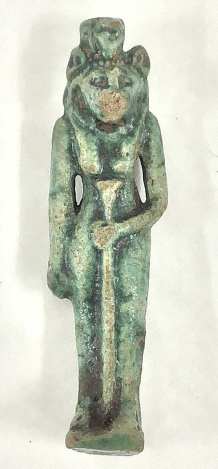
Countless figurines have been found in Egypt, from steatopygous figurines in the Predynastic to blue faience nude figurines, from paddle dolls to innumerable shabtis, statuettes designed to spring to life in the afterlife to work for their master in the Fields of Reeds. This particular figurine – E.6895 – predates the New Kingdom (c. 16th Century BCE) and is something of a curious find. The object comes from Garstang’s excavation at Abydos (1906-1909). The statuette features an elaborate headdress or wig, and is decorated with rounded impressions across the entirety of the figurine. These “punctures” are paralleled on other figurines from the Pharaonic Period.
New Books in Egyptology – July-August 2018

Every two months the Nile Scribes update our readers on the most recent Egyptological publications. From accessible reads to peer-reviewed scholarship, we hope to illustrate the wide variety of topics discussed in Egyptology, and perhaps introduce you to your next read! This summer has seen a vast array of topics addressed through new publications, ranging from astronomy and ceramics to imperialism and tomb robberies. Below are eleven new books that were released this summer (July and August 2018).

Archaeological inspection unearths a partial Ptolemaic necropolis in Alexandria

An Egyptian archaeological mission discovered a Ptolemaic necropolis in Alexandria’s western cemetery while carrying out a preliminary archaeological inspection before erecting an iron gate around a workshop at the Gabal Al-Zaytoun railway station in Alexandria.


Pyramid of Khafre’s maintenance works start after Eid el-Adha
Pyramid of Khafre – Egypt Today.

Head of Central Administration for the Restoration and Development of Monuments, Dr. Gharib Sonbol, stated that maintenance works in the pyramid of Khafre will be held after the Eid el-Adha vacation (Muslim celebrations).

The maintenance is carried periodically by the Ministry of Antiquities in an effort to protect the ancient Egyptian monuments.

Sitchin’s rocket in the tomb of Amenhotep-Huy

Painting of the west wall in the tomb of Huy by Charles K. Wilkinson (1920s),  Image © Metropolitan Museum of Art, New York.

 If you had ever wondered how I came to be writing cranky blog posts debunking memes on the internet, and for that matter, critiquing old art history publications, it is a slightly organic process for me.  I often use the internet for research and I research Near Eastern iconography, which naturally now and then involves searching for images or publications.

After resolutely excluding Pinterest from searches I quite often also come across links to pseudo-science posts that make uninformed claims about ancient art.  Rather than have a complete meltdown, or shun the internet entirely, I write these responses.  It is surprisingly relaxing, my partner sorts stamps, I sort blog posts, in a manner of speaking.

Great Sphinx in Egypt is 800,000 years-old, scientists claim

The Great Sphinx in Egypt is 800,000 years-old, according to a controversial new theory.

A pair of Ukrainian researchers say the mysterious structure is far older than the accepted claim that it was built during the reign of the Pharaoh Khafre between 2558–2532 BC.

Manichev Vjacheslav I. and Alexander G. Parkhomenko say evidence of water erosion at the monuments of the Giza Plateau shows the monument was partially flooded.

What really happened to the Library of Alexandria? - Elizabeth Cox


Picture of the week: Isis Temple, Philae, 1920