Showing posts with label Isis. Show all posts

Monday, January 7, 2019

Ancient Egypt Jan 7 2019


Oriental Institute excavation at Tell Edfu reveals early New Kingdom complex

Bust of a female ancestor found on the floor of the domestic sanctuary. She wears a long tripartite wig and a broad necklace called a wesekh collar. ©GM - Tell Edfu Project 2018

Excavation work led by the University of Chicago’s Oriental Institute team has unearthed a large urban villa dating back to the early New Kingdom, about 1500-1450 B.C.E. The findings at the site of Tell Edfu in southern Egypt include a large hall containing a rare and well-preserved example of a domestic shrine dedicated to family ancestors.

Egypt: Masterpieces of the Bibliotheca Alexandrina Antiquities Museum
Statuette of Thoth facing Maat, bronze

The Bibliotheca Alexandrina Antiquities Museum (BAAM) in Alexandria opened in 2002, and it is probably the only museum in the world built in a library. It houses antiquities found in situ during the construction of the Library of Alexandria.

Having roughly 1,000 to 1,200 pieces, it displays the enormous diversity of Egyptian cultural heritage through the ages. Walking among its treasures means going on a journey through five millennia.

“Dynasty”: When The Pharaohs Of Ancient Egypt Meet Abstract Art
“Anubis X”: from Hassouna’s “Dynasty”

When Ancient Egypt comes to mind, one cannot help but imagine a place of history and culture. A mental image of the bountiful river Nile nourishing an endless desert, allowing our ancestors to flourish in an almost unbearable environment, is formed.

It is a majestic place of magnificent architecture with proud people. Such an adamant portrait of Pharaonic Egypt is always present in our subconscious, unchanging as Ancient Egypt itself. Now, what Egyptian Artist Ehab Hassouna has done to it is revolutionary, to say the least.

This 2,300-Year-Old Egyptian Fortress Had an Unusual Task: Guarding a Port That Sent Elephants to War
A fragment of the northern defense wall, part of the fortress discovered at Berenike along the Red Sea. Credit: S.E. Sidebotham

A 2,300-year-old fortress that protected an ancient port called "Berenike" has been discovered in Egypt on the coast of the Red Sea by a Polish-American archaeological team.

Constructed at a time when Egypt was ruled by the Ptolemies, a dynasty of pharaohs descended from one of Alexander the Great's generals, the fortifications are sizable.

London was once home to an ancient Roman temple dedicated to the goddess Isis
Graffiti on a 1st-century flagon reveals the existence of a temple of Isis. Credit : Markus Milligan

Evidence for a temple dedicated to the goddess Isis was revealed by graffiti on a 1st century flagon unearthed in Tooley Street, Southwark which read “LONDINI AD FANVM ISIDIS” – translated as “To London at the temple of Isis”.

Walk like an Egyptian: Chanel sends models down the runway in Egypt-inspired looks

Models hit the runway in Ancient Egypt-inspired looks as Chanel designer Karl Lagerfeld took his traveling fashion show to New York’s Metropolitan Museum of Art last week. Here are six looks from the show we loved.

WORLD'S OLDEST VILLAGE AND PERFUMERY FOUND IN EGYPT

In the northern Dakahlia governorate, a US excavation mission has dug up an ancient Pharaonic settlement which is being dubbed history's oldest village. The head of the mission, Jay Sleifer Stein, announced the news on Wednesday, in attendance of Dakahlia's Governor Kamal Sharobim and Dean of Tourism Faculty at Mansoura University Dr. Amina Shalaby.


After delays, Egypt’s new mega-museum set to open in 2020

On the Giza Plateau outside Cairo, thousands of Egyptians are laboring in the shadow of the pyramids to erect a monument worthy of the pharaohs.

The Grand Egyptian Museum has been under construction for well over a decade and is intended to showcase Egypt's ancient treasures while drawing tourists to help fund its future development. But the project has been subject to repeated delays, with a "soft opening" planned for next year scrapped in favor of a more triumphant inauguration in 2020. Costs have meanwhile soared from an initial $650 million to well over $1 billion, with most of the financing coming from Japan.

Ancient Egypt holds priceless treasures yet to be discovered

In recent months, archaeologists in Egypt have made spectacular discoveries. And there is much more yet to unearth, but urban sprawl and construction threaten cultural heritage, says German Egyptologist Dietrich Raue.

Be sure to check out the Reading ancient Egyptian video in this article.

Egyptian heritage: Astonishing discoveries in 2018

This year has seen a wealth of new archaeological discoveries and the opening or re-opening of many attractions and facilities, among the most compelling being the discovery of a gilded mummy mask at Saqqara that was chosen as one of the top 10 discoveries of 2018.

Picture of the Week

Cup of the Ptolemies, maybe from Alexandria, Egypt, 3rd to 1st c. BC. Onyx cameo cup. Eventually, it found its way into the treasury of the French kingdom. In 1804, the cup was stolen, and the mounts lost. The cup itself was recovered and is now in the  Bibliothèque nationale de France, Paris.

Monday, September 3, 2018

Ancient Egypt September 3 2018


Labor Day in Ancient Egypt

Labor Day is a holiday in the United States, and one most of us look forward to celebrating. (Who doesn't like a day off work?) This link is to a post I did for Labor Day 2015; to be perfectly honest, not that much changed in ancient Egyptian labor practices since2015.


THE B-LIST: Mystery, mysticism and mummies — uncovering adventure in the deserts of Egypt
Universal Studios

From Indiana Jones to Lara Croft, Nathan Drake to Captain Nemo, you've just got to love a good adventure built around a treasure hunter.

And while the lost Incan cities of Peruvian jungles, Mexico's fabled Fountain of Youth and mountainous Chinese ruins make for memorable settings, there's one place known for magic treasure that never fails to fire the imagination: Egypt.

Hidden Stories of Egyptian Museum

A tour in the Egyptian Museum would take its visitors to ancient Egypt. It is a time travel journey to decipher the symbols of the amazing monuments and to know the meaning of the most important archaeological pieces in the museum.

The Egyptian Museum has an extensive collection of ancient Egyptian antiquities. The museum was opened in 1902, during the reign of Khedive Abbas Helmy II in the heart of Cairo.

Student discovers writing on pieces of ancient Egyptian mummy case
This historical photo shows the ancient Egyptian mummy case on display at the Stanford museum before the 1906 earthquake broke it into pieces. Credit: Department of Special Collections and University Archives, Stanford University Libraries

When Ariela Algaze signed up for a spring 2018 course on museums, she didn't expect to get wrapped up in the mystery of an ancient Egyptian mummy case that Jane Stanford herself purchased more than 100 years ago.

"I was just excited to learn how to put an exhibit display together," said Algaze, a Stanford art history sophomore. "But I became obsessed with finding out everything I could about this artifact."

A Female Figurine from Ancient Egypt

Countless figurines have been found in Egypt, from steatopygous figurines in the Predynastic to blue faience nude figurines, from paddle dolls to innumerable shabtis, statuettes designed to spring to life in the afterlife to work for their master in the Fields of Reeds. This particular figurine – E.6895 – predates the New Kingdom (c. 16th Century BCE) and is something of a curious find. The object comes from Garstang’s excavation at Abydos (1906-1909). The statuette features an elaborate headdress or wig, and is decorated with rounded impressions across the entirety of the figurine. These “punctures” are paralleled on other figurines from the Pharaonic Period.
New Books in Egyptology – July-August 2018

Every two months the Nile Scribes update our readers on the most recent Egyptological publications. From accessible reads to peer-reviewed scholarship, we hope to illustrate the wide variety of topics discussed in Egyptology, and perhaps introduce you to your next read! This summer has seen a vast array of topics addressed through new publications, ranging from astronomy and ceramics to imperialism and tomb robberies. Below are eleven new books that were released this summer (July and August 2018).

Archaeological inspection unearths a partial Ptolemaic necropolis in Alexandria

An Egyptian archaeological mission discovered a Ptolemaic necropolis in Alexandria’s western cemetery while carrying out a preliminary archaeological inspection before erecting an iron gate around a workshop at the Gabal Al-Zaytoun railway station in Alexandria.


Pyramid of Khafre’s maintenance works start after Eid el-Adha
Pyramid of Khafre – Egypt Today.

Head of Central Administration for the Restoration and Development of Monuments, Dr. Gharib Sonbol, stated that maintenance works in the pyramid of Khafre will be held after the Eid el-Adha vacation (Muslim celebrations).

The maintenance is carried periodically by the Ministry of Antiquities in an effort to protect the ancient Egyptian monuments.

Sitchin’s rocket in the tomb of Amenhotep-Huy

Painting of the west wall in the tomb of Huy by Charles K. Wilkinson (1920s),  Image © Metropolitan Museum of Art, New York.

 If you had ever wondered how I came to be writing cranky blog posts debunking memes on the internet, and for that matter, critiquing old art history publications, it is a slightly organic process for me.  I often use the internet for research and I research Near Eastern iconography, which naturally now and then involves searching for images or publications.

After resolutely excluding Pinterest from searches I quite often also come across links to pseudo-science posts that make uninformed claims about ancient art.  Rather than have a complete meltdown, or shun the internet entirely, I write these responses.  It is surprisingly relaxing, my partner sorts stamps, I sort blog posts, in a manner of speaking.

Great Sphinx in Egypt is 800,000 years-old, scientists claim

The Great Sphinx in Egypt is 800,000 years-old, according to a controversial new theory.

A pair of Ukrainian researchers say the mysterious structure is far older than the accepted claim that it was built during the reign of the Pharaoh Khafre between 2558–2532 BC.

Manichev Vjacheslav I. and Alexander G. Parkhomenko say evidence of water erosion at the monuments of the Giza Plateau shows the monument was partially flooded.

What really happened to the Library of Alexandria? - Elizabeth Cox


Picture of the week: Isis Temple, Philae, 1920


Friday, May 25, 2018

Sunken Cities: Egypt's Lost Worlds


I recently saw this exhibit at the St. Louis Art Museum, the first city in America to host it. It will be in St. Louis through September 9. World-renowned underwater archaeologist Franck Goddio and his team discovered  two lost cities of ancient Egypt, which were submerged under the Mediterranean Sea for over a thousand years.

The exhibit is quite well organized and provides ample room for a mass of people.  I went on one of the museum's free days, and every entrance time slot was full, yet, I never felt pushed or crowded. All in all, one of the best exhibits I've seen in some time.

I took several photos, and I hope you enjoy some of them.

While waiting to enter the exhibit, you can study a mural of what they believe the submerged city looked like. The temple looks a lot like Edfu to me, so it might just be their fantasy.


When I visited Egypt in 2006 and 2007, I saw some of artifacts in the exhibit. At the time, they were bringing them up and "stashing" them in a Roman amphitheater in Alexandria. I remember seeing statues resembling the ones shown here, although they were rather crusted in lichen so I can't be sure they were the same ones.

The first statue is of the goddess Isis, if memory serves.

The second statue is of Arsinoe II, which is a magnificent example of Graeco-Egyptian art. The drapery of her dress is amazing. This sculpture might have been a cult statue of Arsinoe in the Serapeum of Canopus

Now, let's get our steles on. It's almost impossible for me to say which one I liked best, although I'm tilted toward the young Horus standing on a crocodile (Set?) and holding snakes in each fist.


I found these statues, both of Osiris, remarkable because they are made of wood, not stone or marble. Only after I read the information and pressed my nose to the glass did I see the wood grain.


And speaking of Osiris. . . . the mysteries of Osiris supposedly became less mysterious based on these findings. I bought the exhibition catalog, which supposedly explains all this, but I have not yet read it. Nonetheless, there were plenty of Osirion pieces, and here are a few of them.

  1. This statue called the Awakening of Osiris has long been a favorite of mine and was not found in the Mediterranean.
  2. Osiris Vegetans Figure in a Falcon-headed Coffin (800-600 BC). This figure is also called a corn-mummy and was formed from earth, Nile flood water, and seeds and then swaddled in linen. They were sprinkled with water until the seeds grew, which symbolized both the rebirth of Osiris and the annual regeneration of Egypt. 
  3. Osiris on Funeral and Revival Bed (1773 -1650 BC) found at Abydos represents the moment when Isis in the form of a kite (bird of prey) revives him with the breath of her wings. The etching behind the statue shows the same story, which I believe is from a carving from the Temple of Hathor at Dendera. 
  4. Osiris-Canopus (AD 100-200) is marble sculpture, which was produced after Egypt  became part of the Roman Empire. 

Horus, Taweret, and the Apis Bull represent the gods as sacred animals.


These beautiful fragments are the god Bes and a sacred ram of the god Amun.

And finally, the most whimsical piece in the exhibition, a commemorative column with a votive foot from the Temple of Ras el-Soda. The temple was dedicated to Osiris, Isis, and Horus. The Greek inscription reads "Flung from his carriage by his horses at the spot, Isidoros, restored to health by divine intervention, in exchange for  his feet." Isidoros dedicated this sculpture to the "Blessed," which was a name frequently used to describe Isis.

For the most recent article on the exhibition, see Sunken Cities: Egypt’s Lost Worlds in Antiquities and the Arts Weekly.

Monday, December 4, 2017

Ancient Egypt December 4


Conspicuous consumption: Edible gold

Ever since the time of the Egyptian pharaohs, gold has been considered to be the only way to win the favor of the Gods. In ancient Egypt, gold leaf was used to decorate the tombs of pharaohs, as well as sarcophagi. The first use of gold has been traced to Alexandria, Egypt, over 5,000 years ago.
New "KING TUT: Treasures of the Golden Pharaoh" Exhibition Will Celebrate 100-year Discovery of King's Tomb with Unprecedented Collection of Priceless Works

A new chapter of ancient Egyptian history will be unearthed to the world with the debut of KING TUT: Treasures of the Golden Pharaoh, an extraordinary and exclusive exhibition celebrating the 100-year anniversary of the discovery of his tomb.

Isis et Osiris en histoire

Illustrations for a book to be published on Egyptian Mythologie : " Isis et Osiris en Histoires"
written by Beatrice Egemar,  Publisher Fleurus Mame

 The illustrations are quite lovely. I can't find any more info on the book or when it's to be published.

Mud brick and termites in Amarna

While famous for its decorated stonework talatat, Amarna was predominantly a mud-brick city. Richard Hughes outlines efforts to protect and stabilise its mud brick ruins.

The siting of Amarna was ideal for its speedy construction via a military-like mass-production campaign making, shifting around and placing down mud bricks (adobes).

Celebrating 115th anniversary of the Egyptian museum
 © Michalea Moore 2017

The Egyptian Museum in Tahrir Square will celebrate on Tuesday, November 28 the museum’s 115th anniversary at 6:30 p.m.

The celebration ceremony, which will take place in the museum, will be attended by Egyptian Minister of Antiquities Khaled al-Anani alongside a group of foreign ambassadors.

Visiting professor reveals secrets of ancient Egyptian mummies

Professor of radiology at Cairo University Sahar Saleem is rewriting history with her research on the mummified pharaohs of the ancient Egyptian New Kingdom.

Saleem presented a few of her findings in the McClung Museum auditorium on Monday night at the 11th annual Harry C. Rutledge Memorial Lecture in Archaeology.


5 minutes with… An ancient Egyptian female figure

Thanks in part to the dry Egyptian desert, this beautiful wood sculpture has survived for some 4,000 years. Antiquities specialist Laetitia Delaloye describes the remarkable piece ahead of its sale in London on 6 December


Foreign diplomats tour Grand Egyptian Museum site ahead of 2018 opening

A delegation of foreign diplomats visited the site of the Grand Egyptian Museum (GEM) on Sunday, inspecting the ongoing construction work in an effort raise the project's profile ahead of its opening in 2018.

New methods for artwork analysis uncover ancient Egyptian practices
(courtesy of John Delaney)

A new blend of imaging technologies has helped archaeologists identify the chemical makeup of an excavated painting, revealing elements of everyday life in second century Egypt.

Researchers from UCLA and the National Gallery of Art in Washington, D.C., published a study earlier this month that examined a more-than-1,800-year-old portrait of a woman. Archaeologists believe the painting, called a mummy portrait because it was found covering the face of a mummified body, depicts a real person who lived in Greek and Roman Egypt.

Pharaonic artifacts found under house in Beni Suef

During a sewage digging operation in the Kom al-Arous village in northern Beni Suef, a worker discovered a stone box and the face of a lion statue believed to be from Egypt’s Pharaonic era.

Secrets of the pyramid builders’ tombs

The pyramid builders’ cemetery on the Giza Plateau has been opened to the public for the first time, 30 years after its original discovery, writes Nevine El-Aref.

At the southern edge of the Giza Plateau lies the pyramids builders’ cemetery with its distinguished architecture announcing to the world that these men were not slaves, as the ancient Greek historian Herodotus claimed, but peasants conscripted on a part-time rotation basis working under the supervision of skilled artisans and craftsmen.

These men, not only built the Pyramids for the Pharaohs, but also designed and constructed their own more modest tombs beside the kings.

New Kingdom axes discovered in Egypt's Aswan

During excavation work at the north-eastern area of Aswan's Komombo temple as part of a project to decrease subterranean water, an Egyptian mission from the Ministry of Antiquities has recently discovered a Hellenic-era limestone block engraved with hieroglyphic inscriptions.
A carpentry workshop was also discovered by a German-Swiss mission led by Cornelious von Pilgrim on Aswan's Elephantine Island in Aswan, where two New Kingdom-era axes were found.

33,000 Egyptian Artefacts are Missing
Credit: Mohamed Abd El Ghany/Reuters

Minister of Antiquities Khaled al-Anani revealed that 33,000 ancient artefacts are missing.

"31,000 of the missed pieces are kept in the house of a citizen, who tried to register them, after the endorsement of the law that allows keeping antiquities under the supervision of the ministry, and bans selling or exploiting them,” Anani said during a parliamentary session.

Discovery of 7000-year-old Egyptian city could shed light on Nile Valley's earliest civilisations
 © Michalea Moore 2017

Archaeologists in Egypt have discovered the ruins of an ancient city and an adjoining cemetery that date back 7000 years to 5,316 BCE. According to a statement by the antiquities ministry, the site can be traced back to Egypt's First Dynasty.

The find was made in the province of Sohag, and is situated 400 meters away from the King Seti I Temple at Abydos city, Egypt Independent reported.

Monday, June 5, 2017

Ancient Egypt June 5


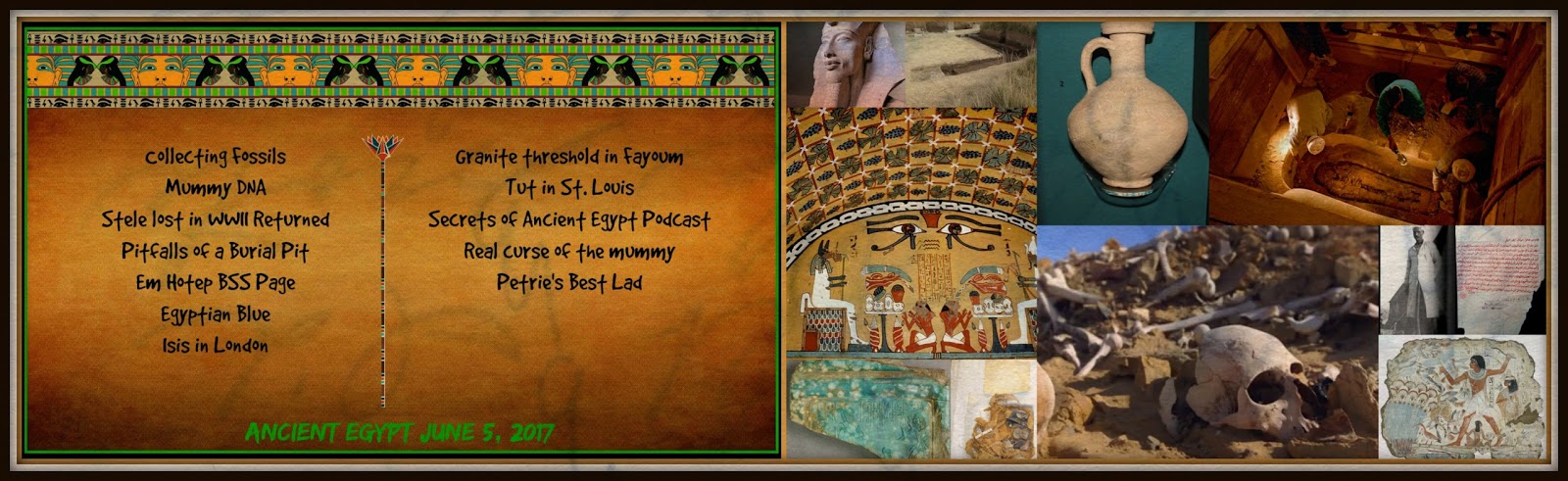
Ancient Egyptians Collected Fossils

Ancient Egyptian worshippers of Set, god of darkness and chaos, collected fossils of extinct beasts by the thousands. From 1300 and 1200 BC, nearly three tons of heavy, black fossils, polished by river sands, were brought to Set shrines on the Nile. Many of the bones were wrapped in linen and placed in rock‑cut tombs.

The immense troves of fossils heaped at Qau el-Kebir and Matmar were discovered in 1922-24 by archaeologists Guy Brunton and Sir Flinders Petrie, stunning evidence that Egyptians revered large stone bones as sacred relics of Set. The god was often associated with the hippopotamus, and many of the fossils belonged to hippos, but remains of extinct crocodiles, boars, horses, giant antelope, and buffalo were also found.

Mummy DNA unravels ancient Egyptians’ ancestry
Petr Bonek/Alamy

Genetic analysis reveals a close relationship with Middle Easterners, not central Africans.

The tombs of ancient Egypt have yielded golden collars and ivory bracelets, but another treasure — human DNA — has proved elusive. Now, scientists have captured sweeping genomic information from Egyptian mummies. It reveals that mummies were closely related to ancient Middle Easterners, hinting that northern Africans might have different genetic roots from people south of the Sahara desert.

Lost Since World War II, Egyptian Artifact Returns to Germany
Credit: © Staatliche Museen zu Berlin, Ägyptisches Museum und Papyrussammlung/Nina Loschwitz

A vivid, turquoise-colored carving from ancient Egypt has been returned to a Berlin museum more than 70 years after it was thought to have been lost during World War II.

The Prussian Cultural Heritage Foundation, which oversees Berlin's state-run museums, announced that the stone slab fragment had been found in the Kelsey Museum of Archaeology at the University of Michigan in Ann Arbor.

The pitfalls of recreating a pit burial

What colour should the sand be? This was just one of the many things we had to think about when installing the pit burial case for the new Ancient Egypt gallery.

The display shows an example of what a very early Egyptian burial looked like, with the remains buried directly into the ground and surrounded by their possessions.

Em Hotep BSS page

If you like talking about Egypt - and who doesn't? - why not take a look at the Em Hotep BSS page. The topics for this summer are listed below.

Image may contain: 1 person


The only requirement is a keen interest in Egypt, the ability to correctly reference any photos, objects, and theories you discuss in your post or comments, and courtesy in discussion.
Fun, friendly group with just those few simple rules.
https://www.facebook.com/groups/119457584880015/
All the Emhotep wonderful banner illustrations are from Ghi Stecyk.

Egyptian Blue: The First Synthetic Pigment
Painting from the Tomb of Nebamun (via British Museum/Wikimedia)

The first human-made blue pigment emerged in ancient Egypt, then disappeared for centuries until it was rediscovered in Pompeii.

The Virgin Mary is often depicted in Renaissance paintings draped in a robe of blue, chosen not just for its heavenly tones, but for the rarity of the lapis lazuli pigment that colored her clothing. Yet long before this hue of ground semi-precious stones, there was a synthetic blue pigment widely used in ancient Egypt. This blue’s creation, loss, and rediscovery cover centuries of human history, from the tombs of Egyptian kings, to the 19th-century archaeological digs at Pompeii, to the modern forensics lab.

Did you know? London was once home to an ancient Roman temple dedicated to the goddess Isis
Credit : Markus Milligan

EVIDENCE FOR A TEMPLE DEDICATED TO THE GODDESS ISIS WAS REVEALED BY GRAFFITI ON A 1ST CENTURY FLAGON UNEARTHED IN TOOLEY STREET, SOUTHWARK WHICH READ “LONDINI AD FANVM ISIDIS” – TRANSLATED AS “TO LONDON AT THE TEMPLE OF ISIS”.

Isis is a goddess from the polytheistic pantheon of Egypt. She was first worshiped in Ancient Egyptian religion, and later her worship spread throughout the Roman Empire and the greater Greco-Roman world.

Spanish mission discovers ancient granite threshold in Fayoum

The Spanish expedition of the Archaeological Museum of Madrid, working in Heracleopolis Magna in the town of Ehansia, Beni Sueif governorate, discovered a large threshold made of red granite while excavating in the Harshaf temple.


Photos: New exhibit on ancient Egypt opens this week at the Saint Louis Science Center

On Thursday’s St. Louis on the Air, Egyptologist Bob Brier joined St. Louis on the Air host Don Marsh to discuss a new exhibit opening at the Saint Louis Science Center.

The exhibit puts guests in the shoes of archeologist Howard Carter when he discovers King Tutankhamun tomb and features recreations of many other artifacts.

“The Discovery of King Tut” opens May 27 and runs through January 7. Listen to the interview to hear about this exhibit and about hundreds of years of Egyptian society. Click here to see more information from the Saint Louis Science Center.

Nature Middle East Podcast

Nature Middle East takes a look at the many secrets of ancient Egypt that archaeology has unlocked recently, from insights into pharaonic funerary and mummification rituals in Luxor to 'shamanic' rock art in Aswan.


Friday essay: desecration and romanticisation – the real curse of mummies
Looting and destruction of mummies at the site of Abu Sir Al Malaq in Egypt. HBO

This June Hollywood’s tomb of old ideas will creak open yet again and present the tale of an ancient Egyptian tomb disturbed by a bumbling archaeologist and/or action-adventure hero, who inadvertently and unwittingly unleashes a curse.
.....

Heard it before? Kurtzman’s film is just the latest in a staggering line of mummy-mania and Egyptophilia predating even the discovery of Tutankhamun’s tomb in 1922. While popular culture has delighted in mummies for over two centuries, in that same time real Egyptian antiquities have been looted, lusted after, and desecrated. In the 19th century, it was even fashionable to host “unwrapping” parties, where mummies were revealed and dissected as a social event within Victorian parlours.

Ali Swayfi: ‘Petrie’s Best Lad’
Photo of Ali Swayfi from: Quirke, S. 2010. Hidden Hands: Egyptian Workforces in Petrie Excavation Archives, 1880-1924. Duckworth Egyptology. London: Duckworth.

Ali Mohamed Swayfi, also known as ‘Petrie’s best lad’ is encountered frequently in the Abydos Paper Archive. In this letter, dated 10 March 1916, he writes to the Director General of Antiquities at the time, Pierre Lacau. He complains to him about the corruption and dishonesty of both the Fayum Inspector and the chief guard (sheikh al-ghofara) and the threats he received from them after he successfully seized objects that had been stolen.

Picture of the week

From the Grand Egyptian Museum

A painting in the tomb of Inherkha TT359, Anubis and Osiris, gods of the Underworld, in front of tables piled high with offerings.The ceiling is decorated with a vine leaf pattern. New Kingdom, 20th Dynasty. Deir el-Medina, Theban Necropolis.