Showing posts with label ancient Egypt. Show all posts

Monday, February 12, 2018

Ancient Egypt February 12


HILDA AND FLINDERS – A RELUCTANT ROMANCE

With Valentine’s Day just around the corner, today’s post takes a look behind the scenes, delving into the archives to tell the story of an unlikely couple, whose tireless work shaped Manchester Museum’s Egyptology collection, and proving that you can find love in the most unexpected places … and that sometimes, opposites really do attract!

Egyptian ibis mummy holds clues to crooks behind ancient clothing caper

The Kunsthistorisches Museum in Vienna has discovered an ancient Egyptian scroll hidden inside a vessel containing a mummified ibis. In the lengthy text, which are business notes, the scribe names three men he accuses of theft. It dates from around 1100BC.

Janet May Buchanan Scotland's forgotten heroine of Egyptology
Cover of the catalogue put together by Janet May Buchanan, 1912. ©CSG CIC Glasgow Museums Collection

Women in Victorian and Edwardian times made a considerable contribution to British Egyptology. The accolades and academic positions, however, were dominated by men. It was a time when female emancipation was the largest domestic issue in Britain and the politics of most Egyptologists in Britain still mirrored the anti-suffrage views of the majority of contemporary society. Although the contributions to the subject by a few women of this period have received the credit they rightfully deserve, most still remain unsung heroines.

All You Need Is Love: Modern Themes in Ancient Egyptian Love Poems
The site of Deir el-Medina; its unusual location has led to a very good rate of preservation(photograph by Kingtut, distributed under a CC A-SA 3.0 license).

It is easy to get distracted by the largest and most obvious material from ancient Egypt – vast tombs, colossal statues and beautiful jewellery. This can lead to a disconnect in our understanding of what ancient Egyptian life was really like – how ‘normal’ people felt, behaved, and acted. One of the ways that scholars try to connect with ancient Egypt at a personal, individual level is through the translation and understanding of literature written by ancient Egyptians themselves; and on Valentine’s Day, what better way is there to do that than to read some ancient Egyptian love poetry?

Edwardian aristocrats went to Egypt hoping for glamour — but they got dysentery instead
The Great Pyramid of Cheops at Giza, 1910 CREDIT: BUYENLARGE 
Was Egypt the first place ever to have been mourned by the seasoned traveller as “ruined”? At the close of the 1900s, a leisured clergyman and Oxford Professor of Assyriology called the Rev Archibald Sayce, who had spent the previous 18 winters cruising the Nile, sold his beloved “dahabiya” – a kind of houseboat, later incarnations of which will be familiar from Agatha Christie’s Death on the Nile – and left Egypt, as “life on the Nile had ceased to be the ideal existence it once was... The smoke of the steamer [had usurped] the sights and scents of the fields”.

Artistic Licence: I was here… in Ancient Egypt
Hieroglyphic graffito of the scribe Ashakhet in the Ptah temple at Karnak. Photograph: CNRS-CFEETK/Pauline Batard

Names, dates, bad jokes, life advice: we find graffiti almost everywhere in modern life.

But not many people realise that scrawling on walls isn’t anything new. At least three thousand years ago, in the dusty heat of Ancient Egyptian temples, people did the very same thing.

Pyramids of the Kingdom of Kush – Map

Image Credit : Valerian Guillo

The Kingdom of Kush was an ancient African kingdom located in Nubia, a region along the Nile rivers encompassing the areas between what is today central Sudan and southern Egypt.

The region was home to three periods of Kushite development through antiquity. The first had its capital based at Kerma (2600–1520 BCE) which was Nubia’s first centralised state with an indigenous form of architecture and burial customs.

Newly discovered buildings reveal clues to ancient Egyptian dynasties (video)

Photo by

G. Marouard

The archaeological excavation of an ancient Egyptian city at Tell Edfu in southern Egypt, led by the Oriental Institute of the University of Chicago, has discovered well-preserved settlement remains dating to an important turning point in ancient Egyptian history, when the pharaohs began to renew interest in the provincial regions in the far south of their kingdom.

For more on this story, see: Ancient Egyptian beer-making facilities found by archaeologists (video).

Scans to shed light on identity of mummified Egyptian baby on display at Maidstone Museum

Scans are to shed more light on the identity of a mummified Egyptian baby – one of the youngest ever discovered – which for centuries was believed to be the remains of a bird.

The rare relic, part of the collection at Maidstone Museum, underwent more tests after it was found to be the body of a miscarried foetus, and not a 2,300-year-old hawk as originally thought.

Picture of the Week

A picture showing some workers weaving linen from the Egyptian Textile Museum.


Monday, January 29, 2018

Ancient Egypt January 29


The Top 10 Secrets of The Temple of Dendur at NYC’s Met Museum
Reconstruction of Temple of Dendur’s possible paint. Image via Met Museum.
The Metropolitan Museum of Art, with its many secrets, houses a wonderful collection of works that date back to ancient times through the Renaissance. Most notably though, the museum is home to a bona fide Egyptian temple!

The Temple of Dendur, as it’s called, is completely open to the public, which means visitors can walk through its doors and hallways, experiencing the temple as it was originally used. Here are 10 of our favorite fun facts about the structure.


Opera Aida Is Coming To The Pyramids But It’ll Literally Cost You A Fortune

Opera Aida is set to be performed in Egypt alongside at Pyramids of Giza stage on the 8th, 9th, and 10th of March. The show is welcoming an audience of 1500 people; this will be the second time it’s played outside the Opera House, the first being played at the Karnak Temple in Luxor in 1987. The audience should expect an entirely different setting and design than any other!

THE MISADVENTURES OF WENAMUN

"This comic is easily the best retelling of an ancient Egyptian story I've ever seen."

--T.G. Wilfong, Professor of Egyptology, Kelsey Museum of Archaeology, University of Michigan
Drawing on one of the earliest literary travel accounts known to man, travel writer Rolf Potts and illustrator Cedar Van Tassel recreate the comic tale of Wenamun, an ancient Egyptian priest whose overseas voyage in search of Lebanese timber resulted in an ongoing series of fiascos.

Unearthing Hatshepsut, Egypt's Most Powerful Female Pharaoh
Lepsius 1843–45. The Metropolitan Museum of Art, New York, Rogers Fund, 1929 

Before the British scholar Terence Gray adopted the name Wei Wu Wei and began his studies in Taoism, he was a budding Egyptologist with an iconoclastic streak. In 1920, seemingly tired of history as it had hitherto been written, he published a biographic study of the Egyptian queen and pharaoh Hatshepsut written not as a dry academic tract, but as a drama.

Nefertiti was no pharaoh, says renowned Egyptologist
The bust of Nefertiti from the Ägyptisches Museum Berlin collection, presently in the Neues Museum.

Contrary to popular opinion, one of the most famous women in ancient history did not rule Egypt, according to a new book.

Dr. Joyce Tyldesley, an Egyptologist from The University of Manchester, says Queen Nefertiti was just one of a series of powerful queens who played an influential role in Egyptian history.

It was, argues Dr. Tyldesley, the beauty of her famous limestone and plaster sculpture—reportedly Hitler's favourite piece of ancient art—which propelled her into the public spotlight after it was put on public display in 1923.

Top Facts about King Ay
Ay receiving the Gold of Honor – Photo Courtesy of Wikipedia

Several secrets around Ancient Egypt and its rulers have not yet been revealed; the magical Egyptian deserts still carry a lot underneath their sands.

Ministry of Antiquities announced that famous Egyptologist, author and former Minister of Antiquties Zahi Hawas will lead an archaeological mission to begin new excavation works at Valley of the Monkeys, located at Valley of the Kings, according to a statement released on the Ministry of Antiquities official Facebook page.

How climate change and population growth threaten Egypt’s ancient treasures
Roger Anis for UN Environment

In his 40-something years as an archaeological excavator on Luxor’s West Bank, Mustafa Al-Nubi has witnessed a flurry of changes.

Tourist numbers have surged, fallen, and then slowly grown again. Local villages have exploded in size. Even the landscape has undergone a radical transformation, as Egyptologists slowly pick their way through the vast Theban Necropolis. “It’s like one big museum now,” Nubi says. “My grandfather would not recognize his own house.”

Researchers use non-visible imaging approach to reveal climate change and population growth threaten Egypt’s ancient treasures

An international team lead by University College London (UCL) researchers has developed a non-destructive multimodal imaging technique that utilizes multispectral imaging and a range of other imaging methods to reveal text from ancient Egyptian mummy cases for research and analysis.

Hidden Ancient Egyptian Paintings Revealed Thanks To New Digital Imaging Tool

Scientists have used a new imaging technique to re-examine Egyptian art and find details that were previously missing.

Linda Evans and Anna-Latifa Mourad from Macquarie University in Sydney, Australia describe in their paper in the Journal of Archaeological Science how they used a technique called DStretch to analyze the ancient paintings. These paintings were found at Beni Hassan, an ancient Egyptian cemetery that’s located near to the city of Minya in modern Egypt.

The Earliest Music in Ancient Egypt video

This video supplements Heidi Köpp-Junk's article, "The Earliest Music in Ancient Egypt," featured in The Ancient Near East Today. Visit http://asorblog.org/2018/01/16/earlie... to read the article.


Ancient Egyptian Humor Video


Horrible Histories - Egyptian Gods and The Devourer - YouTube from Ellen Warburton on Vimeo.

Pictures of the Week

Moving the statue of Ramses II to the Grand Egyptian Museum.


Monday, January 15, 2018

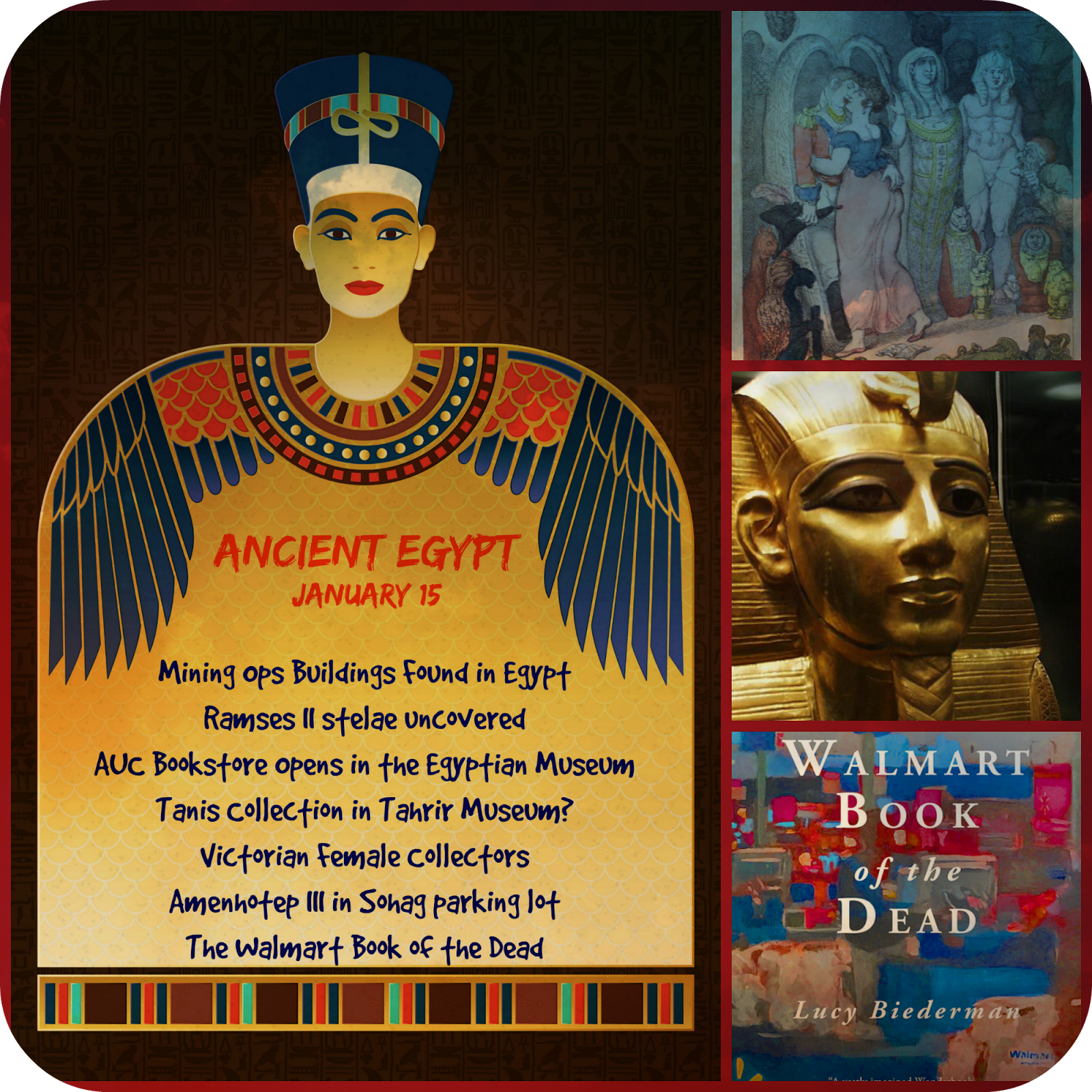
Ancient Egypt January 15


Ancient mining ops buildings found in Egypt — ministry
(AFP photo)

The ruins of two buildings used to supervise mines in ancient Egypt more than 4,400 years ago have been discovered in the south, the antiquities ministry said on Thursday.

The find was made by a US-Egyptian mission in the Tal Edfu area north of the city of Aswan.

Ramses II stelae uncovered at San Al-Hagar site

San Al-Hagar is a very distinguished archaeological site houses a vast collection of temples, among them temples dedicated to the goddess Mut, god Horus and god Amun.

During work carried out at San Al-Hagar archaeological site in Sharqiya governorate with a view to develop the site into an open-air museum, archaeologists stumbled upon a stelae of 19th Dynasty King Ramses II.


AUC Bookstore Opens in the Egyptian Museum in Cairo

The American University in Cairo Press (AUC Press) recently opened a bookstore in The Egyptian Museum, as part of the Egyptian Heritage Exhibition, marking the 115th anniversary of the Museum. “AUC Press and Bookstores regularly take part in events and book fairs but this is a unique and excellent initiative by the Ministry of Antiquities,” said Nigel-Fletcher Jones, director of AUC Press and Bookstores. “Many visitors to Cairo are here on a short, almost whistle stop tour, so this may be one of a few rare moments when they are able to see the huge range of high quality books AUC Press has to offer.”


Will the Tanis Collection replace King Tut’s in the Tahrir Museum?
Note: I was looking for the mask to which they refer, but there are apparently several gold masks in the Tanis Collection. I chose the mask of Funeral mask of Psusennes 1 1, around 994 BCE. 48 cm high. Room 2, 1st Floor from this page.
“The Egyptian Musem in Tahrir will not die, it will continue to receive visitors all year round,” stated Khaled el-Enani, Minister of State for Antiquities, proudly, on more than one occasion. Even now that King Tutankhamun, hereafter referred to as Tut, has been transferred to the Grand Egyptian Museum, the Egyptian Museum in Tahrir still has the Yuya and Tjuyu collection, in addition to the Tanis gold collection which includes a gold mask that could potentially replace King Tut’s mask in the exhibition.

The Victorian female collectors captivated by Ancient Egypt
Thomas Rowlandson Modern Antiquities (hand coloured engraving, c. 1800). Nelson and Lady Hamilton canoodle in an Egyptian coffin, hungrily watched by her antiquarian husband Sir William Hamilton.

In Victorian Britain’s overwhelmingly masculine society, intelligent, driven and often moneyed women were obliged to restrict their energies to acceptable “feminine” activities; like travelling, writing, fund-raising – and amassing impressive collections of Egyptian antiquities.

The results of this male-sanctioned pursuit are said to have greatly helped to establish British Egyptology and boosted the Victorian interest in all things Pharaonic.

Fragment of Black granite statue of King Amenhotep III discovered in Sohag parking lot

The Ministry of Antiquities announced the discovery of an artifact in a parking lot in Akhmim, Sohag governorate, during a drilling operation to develop the site.

The Walmart Book of the Dead

As for who reads this book
And who follows its spells
I know your name
You will not die after your death
In Walmart
You will not perish forever
For I know your name

So begins this darkly comic incantation on the gods and scourges of the 21st century. The Walmart Book of the Dead was inspired by the ancient Egyptian Book of the Dead, funerary texts with accompanying illustrations containing spells to preserve the spirit of the deceased in the afterlife. In Lucy Biederman’s version, shoplifters, grifters, drifters, and hustlers, desirous children, greeters, would-be Marxists, wolves, and circuit court judges, wander Walmart unknowingly consigned to their afterlives.

“This BOOK is for the dark hours, the seam that ties the end of the evening to sunrise, when the bad, wrong things people do in and around Walmart are a hospital infection, red Rit dye in a load of whites, a gun in a classroom: by the time the problem is identified, it’s already ruined everything.”

 So, of course, you'll want to read ‘The Walmart Book of the Dead’‘The Walmart Book of the Dead’ review.

Monday, January 8, 2018

Ancient Egypt January 8


Egypt recovers 3 ancient mummies from US
PROMario Sánchez Prada/Flickr

The Egyptian Ministry of Antiquities announced on Wednesday that it has recovered parts of three ancient mummies from the United States, which had been stolen and smuggled out of Egypt in the early 20th century.

The supervisor-general of the ministry’s repatriation department, Shaaban Abdel Gawad, said in a statement that “the ministry had succeeded following several diplomatic negotiations to recover three pieces of various ancient mummies.”

For more on this topic:


Ancient Egypt VIII: Ancient Egyptians initiate world literature
‘Sinuhe’ story papyrus – Wikimedia Commons

January 2018: Prominent archaeologist and author, Enas El Shafie, traced the origins of Ancient Egyptian history in a TV interview with Ibrahim Hegazy, aired on state-owned TV.

El Shafie has introduced evidence to illustrate how world literature was inspired by Ancient Egyptian heritage, including the stories of Snow White and Cinderella, and narrative poems, like Divine Comedy and Iliad.

Dawn of Egyptian Writing
(Alberto Urcia, Elkab Desert Survey Project)

Archaeologists have discovered an oversized inscription that offers a new glimpse into the early development of the Egyptian writing system. A team led by Yale University Egyptologist John Darnell found the hieroglyphs on a cliff face within view of a desert road north of the ancient city of Elkab. Dating to around 3250 B.C., they were carved during Dynasty 0, a period when the Nile Valley was divided into competing kingdoms and scribes were just beginning to master writing.

BEYOND THE NILE: EGYPT AND THE CLASSICAL WORLD

Ring with portrait of a Ptolemy wearing the Egyptian double crown, about 186 - 145 B.C., gold.
Musée du Louvre. © RMN-Grand Palais / Art Resource, NY. Photo: Hervé Lewandowski.


“Beyond the Nile is the first exhibition to provide a comprehensive overview – spanning more than two thousand years – of Egypt’s interactions with the classical world. It is an unprecedented compilation of works of art from the Bronze Age to the late Roman Empire, drawn from the major museums of Europe and America, as well as the Getty’s own collection,” said Timothy Potts, director of the J. Paul Getty Museum and one of the curators of the exhibition. “From trade, exchange, and artistic borrowings to diplomacy, immigration, and warfare, the cultures and histories of these two civilizations were intimately intertwined for millennia. The monuments and art that resulted provide spectacular evidence of how profoundly these so different cultures affected each other, and indeed the global culture we share today.”

Remains of royal ancient Egyptian artefacts uncovered in Tel Al-Pharaeen

At least one of the pieces uncovered in Kafr El-Sheikh dates to the reign of King Psamtik I.

An Egyptian excavation mission has discovered remains of mud-brick walls and several artefacts that can be dated to different periods of the ancient Egyptian era as well as four furnaces from the Late Period (664-332 BCE) during excavation work carried out in Tel Al-Pharaeen archeological site known as “ancient Buto” in the Kafr Al-Sheikh Governorate.

Scan technique reveals secret writing in mummy cases

Researchers in London have developed scanning techniques that show what is written on the papyrus that mummy cases are made from.

These are the decorated boxes into which the wrapped body of the deceased was placed before it was put in a tomb.

See also Egypt mummy can ‘LIVE FOREVER’ after breakthrough discovery


Verdi’s Ode to Ancient Egypt, ‘Aida’
(Credit: Metropolitan Opera)

Premiering on December 24, 1871, at the Khedivial Opera House in Cairo, Egypt, Giuseppe Verdi’s “Aida” is one of opera’s best-loved and most enduring works. Verdi was commissioned by Isma’il Pasha, who was governor of Egypt, in celebration of the opening of Egypt’s Khedivial Opera House, although the premiere was delayed due to complications from the temporary capture of Paris by Prussian forces.


9 Photos of Extraordinary Mummies, Ancient and Modern
PHOTOGRAPH BY KENNETH GARRETT, NATIONAL GEOGRAPHIC CREATIVE

From thousand-year-old crocodiles to a 20th-century pneumonia victim, these preserved remains tell remarkable stories about life and death.

“There was something strangely touching about her fingertips,” author Chip Brown noted in his impression of the 2,500-year-old mummy of Hatshepsut in our 2009 article on the ancient Egyptian queen. “Everywhere else about her person all human grace had vanished."

SECRETS OF GREAT PYRAMID’S HIDDEN VOID MAY BE REVEALED BY TINY FLYING ROBOT
View of the Great Pyramid from Mena House © Michalea Moore 2017

In November, researchers announced they had used cosmic rays to discover (or maybe more like rediscover) a big, empty space inside the largest of the pyramids located in Giza, Egypt. A team of French robotics researchers is building a tiny blimp that could let scientists peer inside the void and other spaces that are difficult to access.

Picture of the week

Modernized versions of ancient Egyptian art created by Anton Batov, an illustrator based in Moscow, Russia. Thanks to Lyn Green and Pharonoic Phunnies.


Tuesday, December 26, 2017

Ancient Egypt December 26


4 Child Graves Discovered at Ancient Egyptian Site
The Gebel el Silsila Project 2017

The intact graves of four children, the youngest just 2 or 3, have been discovered at an ancient quarry site in Egypt.

Gebel el Silsila was a source of stone for temples and tombs in Upper Egypt during the Thutmosid period, which ran from the beginning of Thutmose II's reign in about 1493 B.C. to the end of Amenhotep II's reign in about 1401 B.C. Since 2015, 69 tombs have been discovered at the site, though most are empty, having been looted in antiquity. The newly discovered children's tombs are different. The burials are intact, and some of the graves

The Tomb: Ancient Egyptian Burial

Although this exhibition is now closed, the slide show and video are still available.

The Tomb was constructed in the great city of Thebes shortly after the reign of Tutankhamun for the Chief of Police and his wife. It was looted and reused several times, leaving behind a collection of beautiful objects from various eras. These are displayed alongside objects found in nearby tombs, giving a sense of how burial in ancient Egypt changed over time.

Italian archaeologists discover pharaohs' fortress

The discovery makes the site one of the largest fortresses on the Nile Delta and the most well-preserved from before the era of ancient Rome.

The discovery was recently made public by the Egyptian Ministry of Antiquities.

Tell el-Maskhuta is situated northeast of Cairo, along the Ismailia Canal.

Three artifacts displayed for first time at Egyptian Museum

The Egyptian Museum began showcasing a new display on Thursday evening of three artifacts, available for the public to see for the first time, as part of celebrations of the 115th anniversary of the Egyptian Museum.

Pictures of Tutankhamun

This winter, Christina Riggs is curating an exhibition of Photographs of the excavation of Tutankhamun’s tomb in Lincoln. It goes along with her book, Photographing Tutankhamun (coming out next year) and her blog of the same name.

Trailer of the exhibition Missione Egitto 1903-1920

Missione Egitto 1903-1920. A mesmerizing travel to the early 1900s, when visionary and courageous men decided to leave for Egypt with the aim to enrich the collections of the Museo Egizio.
A narration through images, objects, documents and voices to live the greatest archaeological adventure.

ALAA AWAD’S STUNNING NEO-PHARAONIC MURALS AND PAINTINGS

Alaa revealed his neo-pharaonic style on Mohamed Mahmoud Street near Tahrir Square in Cairo in 2012. Over the years, he has participated in a number of exhibitions and auctions locally and internationally, and has gained wide recognition for his symbolism and bold colours. His murals and paintings reflect a great love of the past and, at the same time, make an attempt to speak to trends in contemporary society. Elongated figures straight out of a pharaoh’s tomb merge with mythical and folkloric creatures and elements of Sufism to create a grand visual vocabulary that looks both familiar and fresh.

Video tour of Abydos

The video is fantastic. Abydos is one of my favorite places in Egypt. Here I am at the beginning of 2017.
 © Michalea Moore 2017


Picture of the week

Relief of Nun from the burial chamber of Ramses VI.

No automatic alt text available.