Showing posts with label solar boats. Show all posts

Monday, January 6, 2020

Ancient Egypt News: The GEM is Coming 01/06/2020


Grand Egyptian Museum
90 Percent of GEM work is Finished
File - Grand Egyptian Museum

Ministry of Tourism and Antiquities announced that about more than 90 percent of the Grand Egyptian Museum work was finalized. GEM is expected to be inaugurated in the last quarter of 2020.

The inauguration of the Grand Egyptian Museum is one of the main events that Egypt and the whole world is waiting for in 2020.

About 49,603 artifacts were moved to the Grand Egyptian Museum so far.

Khufu Second Boat Project
Salvaging Khufu’s Second Solar Boat
© Khufu Second Boat Project

In the scorching heat of the Giza plateau, the Egyptian Ministry of Antiquities and a team from Waseda University in Japan are engaged in the daunting task of lifting a 4,700-year-old wooden ship from a pit in the ground, just a few meters south of Khufu’s great pyramid.

This is no ordinary excavation; the wooden pieces from the 42-meter-long boat are so delicate that the archaeologists cannot simply remove them from the ground without extensive onsite conservation.

Here's a picture in 2017 I took of the first solar boat at the Solar Boat Museum. If you go to Egypt, plan to visit the museum, which is right outside the Great Pyramid.

Khufu's solar boat
© Michalea Moore

The site of the Grand Egyptian Museum.
Grand Egyptian Museum to Open End of 2020, Ticket Prices Initially Announced
AP Photo/Amr Nabil

The site of the Grand Egyptian Museum. (AP Photo/Amr Nabil)
Egypt’s anticipated national project, the Grand Egyptian Museum, is set to open at the end of 2020, revealed Minister of Tourism and Antiquities Khaled El Enany.

Moreover, the museum’s initial ticket pricing for foreigners has been set to 400 EGP ($US 25), 200 EGP for students ($US 12.5) according El Watan and Daily News Egypt.

How Cleopatra Became a Canvas for Society's Anxieties
Wikimedia Commons

Two-thousand years after her death, Cleopatra continues to enthrall us. Earlier this year, the British tabloid The Daily Star reported that a new movie about this last Pharaoh of Egypt was in the works. According to an anonymous source, the movie will be "a dirty, bloody, political thriller told from a feminist perspective," as opposed to the movie Cleopatra of 1963 starring Elizabeth Taylor, which had been a historical epic.

Book of Two Ways
An Afterlife So Perilous, You Needed a Guidebook
Werner Forman/Universal Images Group, via Getty Images

Archaeologists unearthed the remains of a 4,000-year-old “Book of Two Ways” — a guide to the Egyptian underworld, and the earliest copy of the first illustrated book.

When it comes to difficult travel, no journey outside New York City’s subway system rivals the ones described in “The Book of Two Ways,” a mystical road map to the ancient Egyptian afterlife.

This users’ guide, a precursor to the corpus of Egyptian funerary texts known as “The Book of the Dead,” depicted two zigzagging paths by which, scholars long ago concluded, the soul, having left the body of the departed, could navigate the spiritual obstacle course of the Underworld and reach Rostau — the realm of Osiris, the god of death, who was himself dead. If you were lucky enough to get the go-ahead from Osiris’ divine tribunal, you would become an immortal god.

small royal statue of a sphinx was uncovered in Tuna El-Gebel.
Egypt Amazes the World with 2019 Archaeological Discoveries 

Over the last two years, a large number of new discoveries in Egypt have grabbed the world’s attention. Egypt Today Magazine will provide its readers with a capsule of all the discoveries that occurred in 2019.


Bees!

This is from The Tears of Re, Beekeeping in Ancient Egypt by Gene Kritsky.
Image may contain: 1 person, text

Monday, June 26, 2017

Ancient Egypt June 26


Oh my goodness, there are so many articles on Ancient Egypt this week  So, here we go with lots of news about the new Grand Egyptian Museum.

Tutankhamun artefacts moved to Grand Egyptian Museum ahead of soft opening in 2018

Mummified dates, grains and small model boats were among the objects moved in this most recent batch, an operation that required careful packing and essential restoration work.

Ministry of Antiquities studies using solar energy in GEM

CAIRO – 20 June 2017: Ministry of Antiquities is mulling the installation of renewable energy solar power in the new Grand Egyptian Museum (GEM) in addition to discussing ways of transporting heavy antiquities from Egyptian Museum in Tahrir Square to GEM, according to general supervisor for GEM project Tarek Tawfik.

Ancient Egyptians may have given cats the personality to conquer the world
Ashmolean Museum, University of Oxford/Bridgeman Images

Around 1950 B.C.E., someone painted an unusual creature on the back wall of a limestone tomb some 250 kilometers south of Cairo. With its long front legs, upright tail, and triangular head staring down an approaching field rat, it is unmistakably a domestic cat—the first appearance in the art of ancient Egypt. In the centuries that followed, cats became a fixture of Egyptian paintings and sculptures, and were even immortalized as mummies, as they rose in status from rodent killer to pet to god.

The Mummy Returns: Egyptian Dignitary's Face and Brain Reconstructed

An international team of researchers has reconstructed the face and brain of a 3,500-year-old Egyptian mummy, revealing a unique "packing" embalming treatment.

Consisting of a well-preserved head and canopic jars containing internal organs, the remains belong to Nebiri, an Egyptian dignitary who lived under the reign of the 18th Dynasty pharaoh Thutmoses III (1479–1425 B.C.).

Egypt's sunken antiquities threatened by ship waste
Photo by: AP (Archive )

Oil spills and waste pose harm to Alexandria's ruins, including one of the seven wonders of the ancient world - Pharos Lighthouse. Archaeologist plan on displaying the treasures of the fabled city, but only if the antiquities remain undamaged.

The Grand Egyptian Museum – A Bridge between Ages

The long-anticipated Grand Egyptian Museum (GEM) is set to open officially in May 2018. However, it may partly open ahead of schedule, thanks to a challenging schedule of works.

The Grand Egyptian Museum will be situated adjacent to the Giza Plateau within two kilometres of the Giza pyramids. The GEM project is one of the largest and most significant in process globally. Its total land area extends to 491,000 square metres, with theGrand Egyptian Museum Waleed Abdel-Fattah buildings taking up 168,000 square metres. Once completed it will be a world-leading scientific, historical and archaeological study centre. The museum is set to open in May 2018.


Ancient Tomb of Gold Worker Found Along Nile River

A 3,400-year-old tomb holding the remains of more than a dozen possibly mummified people has been discovered on Sai Island, along the Nile River in northern Sudan.

Archaeologists discovered the tomb in 2015, though it wasn't until 2017 that a team with the AcrossBorders archaeological research project fully excavated the site.

Ancient Egyptian "billboard" could rewrite history of hieroglyphs

Archaeologists from Yale and the Royal Museums of Art and History in Belgium have discovered an ancient Egyptian "billboard" that might turn back the clock on when the hieroglyphic writing system was thought to be introduced to the general population. The huge inscriptions date back to about 3,250 BCE, and show a form of writing that was thought to only be used by the ruling class at that time.

Also see Yale archaeologists discover earliest monumental Egyptian hieroglyphs for a more detailed report.


Egypt’s Final Redoubt in Canaan
© The Israel Museum, Jerusalem, Nachom Selpak

For three centuries, Egyptians ruled the land of Canaan. Armies of chariots and 10,000 foot soldiers under the pharaoh Thutmose III thundered through Gaza and defeated a coalition of Canaanite chiefdoms at Megiddo, in what is now northern Israel, in 1458 B.C. The Egyptians then built fortresses, mansions, and agricultural estates from Gaza to Galilee, taking Canaan’s finest products—copper from Dead Sea mines, cedar from Lebanon, olive oil and wine from the Mediterranean coast, along with untold numbers of slaves and concubines—and sending them overland and across the Mediterranean and Red Seas to Egypt to please its elites.

‘The Mummy’ could have been great if it had been about Ahmanet

This year’s The Mummy turned out to be a wasted opportunity, but what if it had starred Sofia Boutella as princess Ahmanet, in search of power and justice in Ancient Egypt?
. . .
If there was anything worth salvaging from the movie, it was Sofia Boutella’s entrancing performance as Ahmanet, the Mummy, which was played up in the trailers only to be terribly mistreated by the film itself.

Salvaging Khufu’s Second Solar Boat

In the scorching heat of the Giza plateau, the Egyptian Ministry of Antiquities and a team from Waseda University in Japan are engaged in the daunting task of lifting a 4,700-year-old wooden ship from a pit in the ground, just a few meters south of Khufu’s great pyramid.

Monday, April 10, 2017

Ancient Egypt this week: The Pyramid and the Boat


The Pyramid Discovery
Photo courtesy of the Ministry of Antiquities

The remains of a 13th Dynasty pyramid have been discovered by an Egyptian archaeological mission working in an area to the north of King Senefru's Bent Pyramid in the Dahshur Necropolis. Like all discoveries, there is a spate of news stories.

A folk eye on the Egyptian Museum

Egypt's heritage is a field of rich folk culture, made possible by the life-sustaining Nile.
Egypt's folk culture is a vivid and subtle realm where past and present come together. In a series tracing the folk element inside the Egyptian Museum in Cairo, Ahram Online went on an exceptional tour.


Facts You Never Knew About the Pyramids of Giza
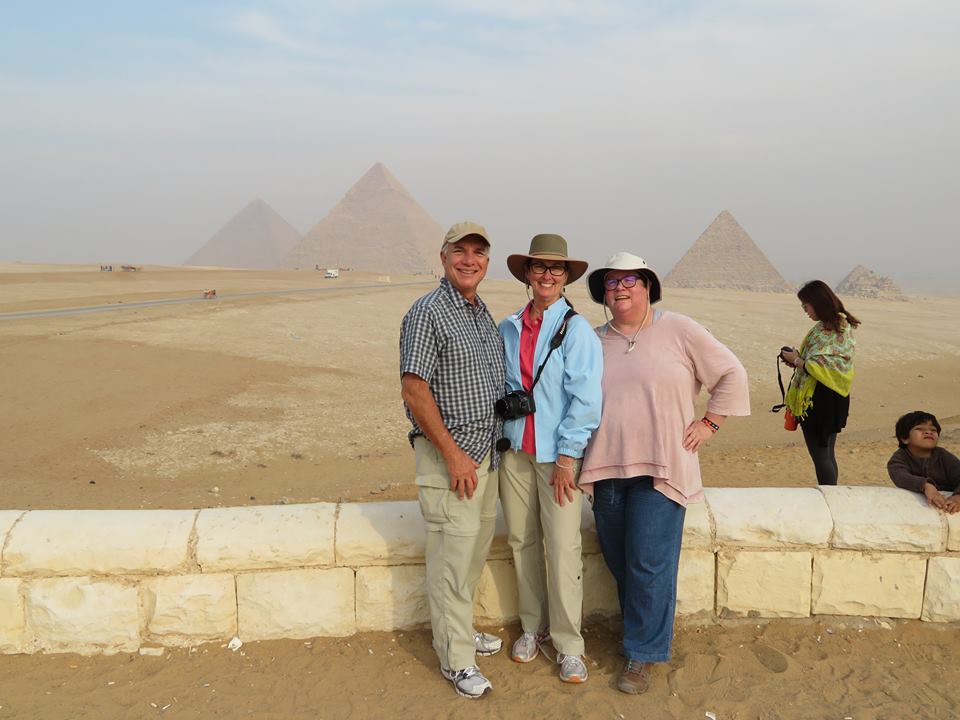
Photo courtesy of me and my last visit to Egypt in January 2017.

It’s no wonder that our fascination with the pyramids of Giza have endured for millennia. The massive Great Pyramid—built for the Pharaoh Khufu and finished around 2560 B.C.E.—is the only marvel of the original Seven Wonders of the Ancient World still intact. And the rest of the complex is nothing short of brilliant, too. Perched on the outskirts of Cairo, the Giza site contains six pyramids in total: three towering ones, including the Great Pyramid, and three smaller ones—plus an enormous statue of a sphinx, for good measure.

NORTH-EAST CASTLE’S EXHIBITION OFFERS CHANCE TO LEARN MORE ABOUT ANCIENT EGYPTIAN ARTEFACT

A historic North-east castle’s little known links to ancient Egypt have been revealed.

It comes as Castle Fraser prepares to host some of the region’s top museum artefacts in a new exhibition.

But the ancient objects, which include amulets and a mummy’s head – affectionately known as Marlon – have an unexpected connection to the castle, near Sauchen.

Sandals for the king

My latest project on ancient Egyptian beadwork focuses on the research of how a pair of small beaded sandals, found in the tomb of Tutankhamun, were made 3.300 years ago. This work will include the analysis of the ancient beading craft and the description of the beading pattern. In the coming months, I will then be making reconstructions of these objects for an exciting new exhibition on ancient footwear in the Bata museum in Toronto (Canada).

ANCIENT ALEXANDRIA'S IMPERIAL BATHHOUSE READY FOR VISITORS
Photos by Egypt Independent

The newly opened bathhouse dates back to the 4th century and has been under excavation since 1960. It is now set to become an important part of a touristic trail in Alexandria.

Yesterday, Minister of Antiquities Khaled EL-Enany along with members of parliament reopened Alexandria’s cistern and imperial bathing complex area, dating as far back as the 4th century, in the Kom El-Dikka archaeological site.

Egypt unearths part of ancient King Khufu's boat
(AP Photo/Amr Nabil)

A plank of wood believed to be from the boat of an ancient Egyptian king has been unearthed near the Great Pyramid at Giza, archaeologists said on Wednesday.

The boat, which is the second such vessel to be found on the site, was believed to have been built for King Khufu who ruled Egypt during the fourth dynasty more than 4,500 years ago.

First discovered in the 1980s, experts say they have so far uncovered 700 pieces of the boat from the site and now believe that they have unearthed most of its pieces.

Khufu's solar boat is one of my favorite visiting sites in Egypt. Sometimes, I am almost more in awe of it than anything else when I gaze upon the deck and see the grooves worn into the wood 4500 years ago. Here's my photo from my last visit in Egypt in January.


For other stories on this find:


Sandstone statue of a Chief of the Police and his wife seated side by side, wearing long pleated robes and wigs: Sheikh Abd el-Qurna, Thebes, Egypt, c.1323–1279BC

A chief of police, ten princesses and a high official from a Roman-era Egyptian family are all helping Dr Margaret Maitland with her enquiries.

The Senior Curator of the Ancient Mediterranean collections at National Museums Scotland is the ‘detective’ behind a search for clues into the mysterious affair of ‘The Tomb’.

Eat like an Ancient Egyptian

We know a lot about the Ancient Egyptians, thanks to this great ancient civilisation. Their desire and propagandist need to disclose what they did was paramount, especially for the pharaohs. They made sure their successes were touted everywhere. Rameses II was particularly good at promoting what a powerful and good ruler he was, even when the war he waged on the Hittites wasn’t a victorious campaign. If it wasn’t for the first pharaoh, Menes, of the 1st Dynasty to the Ptolemaic period, the last ruling pharaoh Cleopatra, who recorded everything, we’d know very little about this dynamic civilisation. Thank goodness, they did!

Photos of the week

The Two Eyes from the limestone sarcophagus of Queen Kawit, wife of King Montuhotep II (ca. 2051-2000 BCE). Now in the Cairo Museum.


Guardian statue of Nephthys, sister of Osiris, mourning the deceased Meret-it-es Egyptian 30th Dynasty to early Ptolemaic Dynasty 380-250 BCE.

No automatic alt text available.

Monday, November 7, 2016

Ancient Egypt this Week: Abydos Boats & Underworld Navigation


Five Museum and Exhibition Books to Run and Get

From the Egyptians blog, just in time for the holiday season and the Egypt-o-phile on your list.
About once a year I make suggestions of what books or guides will be of interest as gifts for my reader's loved ones and friends who are interested in art and Egyptology. I am of course a giant fan of museum and exhibition guides as they usually contain objects and artifacts that are rarely if ever published elsewhere. 
22,000 sign up to learn the secrets of ancient Egypt
(Emma Lee/WHYY)

David Silverman is one of the world's foremost authorities on ancient Egypt. Whenever a crackpot theory about Egypt comes to the surface - like how space aliens must have built the pyramids - he is asked to comment.

He doesn't mind. Even wackadoo questions lead to interesting answers.

Archaeologists Reenact 19th-Century Mummy Ritual
 Photos by Cydney Scott

In the late 1800s, the hottest ticket in town would get you into an event where an Egyptologist and a doctor crouched over a 3,000-year-old mummy and slowly unwrapped its bandages “for scientific purposes.” In the spirit of Halloween, and with a more than seasonal interest in archaeology, about 70 students and guests gathered Thursday night at the Castle to do the same thing at a sold-out event called Unrolling Egyptomania.

TT40, the tomb of AMENHOTEP, surnamed  HUY

Tomb TT 40 is in the Theban necropolis at Qurnet Mura’i. This is one of very few tombs datable with certainty to the reign of Tutankhamun. The owner is called Amenhotep, but prefers to be called the most familiar diminutive of Huy; he undertakes the very important function of "King’s Son of Kush, Overseer of the Southern Countries", in other words, he is Viceroy of Nubia.

The tomb of Huy is one of our major sources for understanding the functions of a Viceroy: the scenes showing presentation of the tribute to the sovereign are exceptional examples of such work and created the reputation of this monument. Another interesting point is the mixture between ‘classic’ elements and others that recall the Amarna period - which had just ended.

Graphic of the Day - Catastrophic Hieroglyphs


Image by Dom McKenzie (all rights reserved).

Twitter had this cool modern appropriation/reinterpretation of Egyptian hieroglyphs applied to contemporary concerns about impending and ongoing mayhem. It accompanied the fascinating and insightful article "What the ancient past can teach us about the chaos of 2016."

3,800-Year-Old 'Tableau' of Egyptian Boats Discovered
Wiley Online Library Photo

More than 120 images of ancient Egyptian boats have been discovered adorning the inside of a building in Abydos, Egypt. The building dates back more than 3,800 years and was built near the tomb of pharaoh Senwosret III, archaeologists reported.

This story is blowing up the news. You can read bits and pieces in the following articles, or you can read the full, scholarly article in The International Journal of Nautical Archaeology.


How I became a Mummy by Leena Pekkalainen The American University in Cairo Press (AUC Press)

If you thought making an ancient Egyptian mummy was just a matter of wrapping a body in bandages, think again! It was a long, complicated, and sometimes gruesome process.

What happened to the intestines, lungs, and other soft inside bits?
How did they get the brain out of the skull? What did they use to dry the body out, and how long did that take?

These questions and many more are answered here by Mr. Mummific, a king of Egypt who went through it all himself, and ended up a mummy with attitude.

A little confused when he first died (but relieved that he no longer had toothache), he needed his own guide to explain things, so it's lucky that his dead but cheeky son was there to lead him by the hand. Together, they let us in on all the grisly secrets of the embalmers' tent.

Illustrated with eighty colorful scenes from the life, death, and afterlife of the funniest mummy you'll ever meet, How I Became a Mummy is an icky treat for children and Egyptologists of all ages.

Discovering sunken city, gateway of ancient Egypt to outer world
(Hilti Foundation photo) | Xinhua | Manila Bulletin

ALEXANDRIA, Egypt — Around 16 years after his discovery of the submerged ancient Egyptian city of Thonis-Heracleion, French underwater archaeologist Franck Goddio still recalls the discovery as one of the most “fascinating” moments in his life.

This intact stele, 1.99 meters high, bears the inscription of the Decree of Sais, which was commissioned by Nectanebo I (ruled 378-362 B.C.) The stele came to light in the city of Thonis-Heracleion and is almost identical to the stele of Naukratis from the Egyptian Museum in Cairo.

Preview: Animal Mummies Revealed

In Liverpool, 1890, an unusual event took place: 180,000 mummified Egyptian cats, 19.5 tons worth, were auctioned at the docks, the majority destined to be ground up and used as fertiliser on fields across Merseyside.

That’s just one of the fascinating details disclosed to visitors of Animal Mummies Revealed at the World Museum in Liverpool. Combining mummified specimens such as crocodiles, jackals, birds and cats (several survived the grinder) with cultural relics, travel journals and photographs from Egypt, the exhibition will also examine the history and future of scientific study alongside the change in attitude toward ancient artefacts.

Ancient Egyptian plants to tell the story of a civilisation

Elshafaey Abdellatif Elshafaey is part of a new generation of Egyptian archaeological scientists changing our understanding of the past.

Elshafaey, a doctoral candidate in the Department of Botany and Microbiology at Helwan University, is trying to understand how the development of the ancient Egyptian state in the 4th Millennium BCE changed the environment, agricultural regimes, diet, and food economies.

Two new pharaonic cemeteries discovered in Aswan

Two rock-carved cemeteries belonging to the Late Period of ancient Egypt have been discovered close to the shrine of Agha Khan, located west of Aswan, the Antiquities Ministry said in a press release on Monday.

Nasr Salama, head of the ministry’s department for Aswan and Nubia antiquities, said the two cemeteries were badly preserved, with no inscriptions were found on the walls.

Navigating the Underworld


Monday, October 3, 2016

Ancient Egypt this week: Fit for a king


IT'S A PHARAOH'S MASK, BUT NOT AS WE KNOW IT

This is the golden mummy mask of the 21st Dynasty King Amenemopet.

The mummy mask of King Amenemopet reveals an Egypt that was fast running out of gold.

The diary of Minnie C. Burton

The woman behind the man behind the camera: re-discovering the tomb of Tutankhamu

The diary presented here belonged to Minnie C. Burton, wife of the British archaeologist and photographer Harry Burton, who worked with Howard Carter during the excavation of the tomb of Tutankhamun. It is one of only a few surviving items from the couple’s personal belongings and papers, as the extract reproduced above helps explain.

The Griffith Institute acquired it at auction on 14th July 2015 thanks to two generous grants from the Friends of the National Libraries and the Heritage Lottery Fund.n

A cruise fit for a king

Was Khufu’s second solar boat intended for a Nile cruise rather than to transport the pharaoh through all eternity, asks Nevine El-Aref.

The newly revealed wooden beam with pieces of metal on it that has been taken from the pit of the ancient Egyptian Pharaoh Khufu’s second solar boat on the Giza Plateau has raised controversy over the original use of the boat.

Egyptian Museum's 'piece of the month' contest looks to military history for October

To mark the anniversary of the 6 October victory in the 1973 Arab-Israeli war, the Egyptian Museum has selected nine artefacts from its collection that highlight the Egyptian army in ancient times to be put to the vote on Facebook for its “October piece of the month.”

New discovery in Matariya points to a King Ramses II temple

The Egyptian-German Archaeological Mission at Matariya archaeological site discovered new evidence that may lead to a temple of King Ramses II.
Dr Mahmoud Afifi, the head of the Ancient Egyptian Sector at the Ministry of Antiquities, stated that this evidence was found about 450 metres to the west of the obelisk of King Senusret I in Matariya. It was discovered when the mission stumbled upon a number of blocks from the temple courtyards and fragments of the temple statuary.

Grave of Victorian author who was buried alongside her female partner is given listed status in new campaign to recognise gay history 

Adventurer Amelia Edwards was a prominent women's rights campaigner
She wrote eight novels while travelling with her partner Ellen Braysher
The adventurous pair threw Victorian convention aside and went abroad
Four other landmarks have been upgraded to record their LGBTQ histories.

'Revealer of Secrets': Zahi Hawass's new TV show on archaeology to launch in October

Beginning October 20, Egyptian audiences will be treated to a new programme on Egyptian archaeology hosted by former minister of antiquities Zahi Hawass, titled "Kashef Al-Asrar" (Revealer of Secrets). In collaboration with renowned Egyptologists, the programme will launch on Egyptian satellite channel Al-Ghad.