Monday, July 31, 2017

Ancient Egypt July 31


The disappearing Sun Temple of Queen Nefertiti
The head of an Amarna princess on a Kom el-Nana block.

Kom el-Nana, site of a solar shrine for Nefertiti, is one of the last surviving peripheral cult complexes of ancient Akhetaten. Jacquelyn Williamson talks about her work reconstructing wall reliefs from the site, and its precarious condition.

37 Questions with UCLA Egyptologist Kara Cooney

Kara Cooney, a UCLA associate professor of near eastern languages and cultures, is a recognized expert on ancient Egypt, specifically the art and architecture. She specializes in coffin studies, economies in the ancient world and the female pharaoh Hatshepsut. Also among her areas of interest are gender issues of death in ancient Egypt, funerary arts in the ancient world and ritual studies.

In this video, she visits the Los Angeles County Museum of Art and answers questions about her work, ancient Egypt and studying culture in Los Angeles: "Los Angeles has every culture. It's a multi-cultural extravaganza."

Police foil attempt to steal goddess Isis statue in Nubia Museum

Police and employees of the Nubia Museum in Aswan on Sunday foiled an attempt to steal a statue depicting goddess Isis breastfeeding her son Horus.

A statement from the Antiquities Ministry indicated that the attempt occurred some time between 1:00pm and 4:00pm, when the museum was closed for lunch.

Was This Masterpiece Painted With Ground Mummy?

For centuries, European artists adorned their canvases with pigment made from the pulverized remains of ancient Egyptians.

Eugene Delacroix's most famous painting, "Liberty Leading the People," hangs in a revered spot in Paris' Louvre Museum. Inspired by the 1830 Paris Uprising, it has been held up as an embodiment of the French national ethos, and most recently as a justification for the country's controversial burkini ban.

But "Liberty Leading the People" may also have been literally painted with people.

New pharaonic tomb unearthed in Sharqia

The Egyptian Archaeological Mission of East Delta unearthed a pharaonic tomb in the city of al-Hosayneya in the al-Sharqia governorate.

Head of the Egyptian Antiquities Department at the Ministry of Antiquities Ayman Ashawi said that the tomb was discovered when a citizen who wanted to expand their house requested the land to be dug up.

The British Museum publishes the first 3D scan of the Rosetta Stone online

You no longer have to visit the British Museum in London to see the Rosetta Stone in detail. Last week, the museum published the first 3D scan of the famous slab of hieroglyphics online at Sketchfab, where its accompanied by the websites new sound support feature.


Pictures of the week

Isis-knot, the “Tyet”, personified as a Goddess the Tyet-Goddess is represented supporting the sky, and on her arms there are two Ankh-signs; she is flanked by the two eyes (the left eye, the eye of Horus, and the right eye, the eye of Ra), falcon, and a vulture. From the coffin of Amonemopet, Priest of Amon, 1069-945 BC. Louvre Museum.

No automatic alt text available.

The road to Giza pyramids circa 1908.

Image may contain: sky and outdoor

Saturday, July 29, 2017

Video Friday: Beauty


Since I'm at the Romance Writer of America Conference this week, so it seems only reasonable that the videos this week touch on beauty, one of the ingredients of romance.

Cosmetics in Ancient Egypt


Beauty and Makeup in Ancient Egypt


Historically Accurate: Ancient Egyptian/Cleopatra Makeup


Hair History: Ancient Egypt

Monday, July 24, 2017

Ancient Egypt July 24


The mysteries that still surround King Tut, Ancient Egypt's youngest pharaoh
Carsten Frenzl from Obernburg, Germany

A team of archaeologists have discovered Tutankhamun's wife tomb, but many questions still remain

Earlier this month a team of archaeologists discovered evidence of a previously unknown tomb in Egypt's Valley of the Kings. It could belong to King Tutankhamun's wife, Ankhesenamun. . . .  The fate of Tutankhamun's wife is not the only mystery that surrounds the pharaoh, perhaps the most famous king in Ancient Egypt's history.

Ancient Egypt’s Animal Mummies Are Hiding Secrets Beneath Their Wrappings
Baboon Appliqué from an Animal Mummy. Possibly from Saqqara, Egypt. Ptolemaic Period, 305–30 B.C.E. Linen, 51/2 x 23/8 in. (14.2 x 5.6 cm). Brooklyn Museum; Charles Edwin Wilbour Fund, 37.272E. (Photo: Gavin Ashworth, Brooklyn Museum)

Millions of animal mummies have been found in Egypt, but experts are only beginning to understand their true purpose.

Egypt is world famous for its mummies, especially those with royal ties. However, while the ancient empire’s pharaohs Tutankhamun, Hatshepsut and Ramses II rank among its most prominent archaeological discoveries, lesser known but equally significant finds include millions of mummified animals.

National Museum of Egyptian Civilisation receives 453 artefacts

Before displaying, the artefacts shall be subjected to first aid restoration and documentation.

After its first phase soft opening, the National Museum of Egyptian Civilisation (NMEC) received on Monday 453 different artefacts from the first and second Egyptian dynasty that were stored at the Egyptian museum, according to a statement published at the Ministry of Antiquities’ Official Facebook page.

King Tut's Wife May Be Buried in Newly Discovered Tomb

Note: May is the key word. It seems likely there is a tomb. It MIGHT be Ankhesenamun's.

Famed archaeologist Zahi Hawass and his team say they've found evidence of a tomb that could belong to King Tut's wife.

The archaeologists eventually plan to excavate the new tomb, which is located near the tomb of the pharaoh Ay (1327-1323 B.C.) in Egypt's Valley of the Kings, Hawass told Live Science.

Omm Seti in the Abydos Archives

When thinking of famous Egyptologists, the name Bulbul Abdel Mageed probably doesn’t ring a bell. It might not occur to you that it is the name of someone who had tremendous love and admiration for ancient Egyptian civilization, especially for the Temple of Seti at Abydos. Bulbul was a very distinctive individual and scholar of Abydos, better known as Omm Seti.

Petrie, The Ten Temples of Abydos, Harpers Magazine, November 1903 Issue
At Abydos, c. 1915

A rare contemporary article by Petrie that shows the process he went through as he tried to understand the earliest history of dynastic Egypt. Beware the error in dates, and the different use of names, and some real 'howlers' from a modern point of view, but do enjoy the early archaeological processes.

The village where ancient Egypt lives on

Zeinab Badawi's quest to uncover the history of Africa continues with a visit to the Pharonic Village in Cairo, where she explores the most famous civilisation on the continent - the ancient Egyptians.

I went to Pharonic Village on my first visit to Cairo; it was both glorious and cheesy.

Pharaonic Getting a Deluxe Retail Copy

Pharaonic is a game that released last year in digital format only as part of the ID@Xbox program. It's described by many as a side-scrolling Dark Souls in 2.5D and is set in ancient Egypt. Intriguing as that might sound, it seems to have slipped under many people's radar with only 276 of our members having played it.

TT82, the tomb of Amenemhat

Amenemhat lived during the first half of the 18th dynasty and had his tomb prepared during the reign of Thutmosis III, in the necropolis of Thebes, on the hill currently occupied by the village of Sheikh Abd el-Gurnah.

If one is primarily interested in his main offices, "steward of the Vizier", and "scribe who reckons the corn in the granary of divine offerings of Amun,” he appears to us as a subordinate personage. He seems the servant of another, and a simple scribe in an immense institution which has hundreds of such servants.

Tausret: Forgotten Queen and Pharaoh of Egypt book review

Tausret is a collaboration between Richard Wilkinson, who is Regent’ Professor of Egyptian Archaeology and Director of the Egyptian Expedition at the University of Arizona, and some of the most recognizable names in current Egyptology.

Written for a general audience, but with all the details a specialist looks for in a good book, Tausret is one of those books that will teach you about Egyptology while entertaining you with an adventure. But it’s not the sort of swashbuckling adventure you might get with, say Belzoni. It’s more of a detective story, spread out over a lot of detectives.

Pictures of the week


  1. Bullock among papyrus reeds (faience). New Kingdom, 18th Dynasty, Amarna Period, ca. 1353–1336 BC. Now at the Louvre.
  2. A grain mummy is in the shape of Osiris and lays in a wooden coffin with a falcon lid. The grain mummy is filled with barley or grain and then water is poured over it. When the barley or grain starts to grow the mummy becomes the symbol of new life and a good harvest. These grain mummies were ofter used in temples rituals and were buried inside the temples compounds. Osiris is wearing the red crown of Upper Egypt. Egyptian, Hellenistic Period, 330 - 30 B.C. Location and date unknown. Source: Museum of Fine Arts, Boston


Friday, July 21, 2017

Video Friday: Carter and Tut, Tut, Tut


With all the hub-bub about maybe finding the tomb of Ankhesenamun, the wife of King Tutankhamun, it seems only appropriate that we view some vintage footage of the discovery of his tomb. If nothing else, watch the last video for your amusement.

Howard Carter and Tutankhamun's Tomb (with archival footage)


The Excavation Team


Poisoned Wine - The Discovery Of Tutankhamen


Tut-ankh Amen's Tomb (1923) | BFI


Tutankhamen's Tomb (1922)


Howard Carter Google Doodle Tutankhamun's tomb 1922


The explorer Howard Carter working on the inner coffin of Tutankhamun (for your amusement)


Monday, July 17, 2017

Ancient Egypt July 17


Everything you ever wanted to know about the Rosetta Stone
The Rosetta Stone on display in Room 4.

You've probably heard of the Rosetta Stone. It's one of the most famous objects in the British Museum, but what actually is it? Take a closer look...

There are several excellent videos in this blog post from the British Museum.

What Is the Rosicrucian Egyptian Museum and Why Is It in San Jose?
The Rosicrucian Digest, published continuously from 1915, is put out by The Ancient and Mystical Order Rosæ Crucis, which also runs the Rosicrucian Egyptian Museum in San Jose. (Courtesy of the Rosicrucian Egyptian Museum)

f you attended sixth grade anywhere in or near San Jose, there’s a high likelihood you’ve been to see the largest collection of ancient Egyptian antiquities on public display anywhere west of the Mississippi.

I’m talking about the Rosicrucian Egyptian Museum.

Greek archaeologist unearths ancient buildings and bridge in Alexandria, Egypt

Greek archaeologist Kalliopi Papakostas has unearthed ancient buildings and a bridge in the Shalallat Gardens area in Alexandria, Egypt.Excavations in the area had started 21 years ago and now archaeologists have discovered a long carved tunnel that sheds new light to the huge ancient building that has been found so far, Athens Macedonia News Agency reports.

Ancient High House Hosts The Splendour of Ancient Egypt

The splendour of Ancient Egypt comes to Stafford with an exhibition at the Ancient High House exploring the art and culture of Ancient Egypt.

How ancient China and Egypt developed similar structures

Although ancient Egypt and China never communicated with each other, they had many things in common. The exhibition "China and Egypt. Cradles of the World" shows inventions made in both countries a long time ago.

Nilometers Revisited
(This is an expanded version of a previous post about nilometers. It will appear in the August 2017 edition of Egypt Today)The nilometer at the end of Elephantine Island, Aswan (Photo courtesy of Mohamed Fahmy)

Nilometers were used in Egypt, particularly during the pharaonic, Roman and medieval periods, to measure the Nile’s water level during the annual summer flood.

Essentially, apart from such ritual functions they may have served in ancient Egypt, nilometers worked on the Goldilocks principle as far as the rulers of Egypt were concerned.

How to Make a Mummy in 70 Days or Less
The face on the mummy of Queen Nodjmet, wife of Herihor, the high priest of Amun in Thebes. 21st dynasty. Egyptian Museum, Cairo
PHOTOGRAPH BY BRIDGEMAN/ACI

For thousands of years, ancient Egypt’s professional embalmers blended science and magic to unite body and soul for the hereafter.

Throughout the 1800s, the new archaeological discipline of Egyptology fed a keen public appetite for stories about pyramids and mummies. An 1869 story by Louisa May Alcott, “Lost in a Pyramid,” recounts an archaeologist bringing down a curse on himself when he destroys the mummy of a young girl.

Still Searching for Amenia

This statue is of the last king of ancient Egypt's 18Th Dynasty, Horemheb, who reigned from about 1323-1295 BC. The statue was found at his Saqqara tomb he had created before his accession to kingship. Here the king is seated next to his likely first wife Amenia, and sadly this is what the statue looks like today in Luxor.

A tomb was not simply a place for the burial of remains

In ancient Egypt, a tomb was not simply a place for the burial of remains, but rather the site of quite literal rebirth. Here, the individual’s soul was born again, into the afterlife. But surprisingly, the ancient Egyptians believed that to make this rebirth possible for a woman, it was necessary that she briefly turn into a man, in order to conceive the fetus of her reborn self. Guided by new research inspired in part by feminist scholarship, our collection exhibition A Woman’s Afterlife: Gender Transformation in Ancient Egypt explores how this process was thought to take place.

Completing 90% of Djoser Pyramid restoration work

Alaa Shahat, Director of Saqqara Antiquities area, said that the restoration work in the pyramid of Djoser is resumed now after Eid el-Fitr holiday.

Shahat explained that 90 percent of the restoration work is finished in order to speed up maintenance and deliver the pyramid on the scheduled time. ‘’ The restoration of the external body of the pyramid will be completed after two months,’’ said Shahat.

The Book of the Dead of Ramose: Special viewing of an Egyptian masterpiece with video

The Book of the Dead of Ramose is one of the finest examples of this type of funerary papyrus to have survived from ancient Egypt. It was discovered by Flinders Petrie in a tomb at a site called Sedment, south of Cairo, and brought to the Fitzwilliam Museum in 1922. Since then it has had very little exposure to light and thus the vibrant colours of its illustrative vignettes are very well preserved. In 2007, after a period of conservation, it was displayed, in sections, in a short exhibition at the museum, and a small section was also included in last year’s Death on the Nile exhibition.

For one day only, the papyrus will be displayed, laid out in one long stretch, in a single gallery to allow visitors to view it for themselves. Experts will be on hand to answer questions. Numbers of visitors will be controlled and viewing will be on a first-come-first-served basis.

Egypt Uncovered: Belzoni and the Tomb of Pharaoh Seti I

To coincide with the 200th anniversary of the discovery of the tomb of Pharaoh Seti I by the Egyptologist Giovanni Battista Belzoni (1778–1823), Sir John Soane’s Museum will present Egypt Uncovered: Belzoni and the Tomb of Pharaoh Seti I – a new exhibition revealing the story behind the Museum’s most treasured possession.

. . .On 17 October 1817, Belzoni made his finest discovery. Having forged an entrance through the great temple at Abu Simbel, he found the tomb of Ramesses’ father, Seti I comprising ten vividly painted chambers decorated with thousands of hieroglyphs, and Seti’s elaborately carved white alabaster sarcophagus.

Pictures of the week: Isis and Hathor

The goddess Isis, decorative detail of sarcophagus of Queen Tuya, mother of Ramesses II, (gilded wood). New Kingdom, 19th Dynasty. Egyptian Museum, Cairo.

No automatic alt text available.

Detail of ancient Egyptian wall painting depicting cow goddess Hathor suckling child king Amenhotep II (painted sandstone), from the Temple of Thutmose III at Deir el-Bahri. Egyptian Museum, Cairo.
No automatic alt text available.

Friday, July 14, 2017

Video Friday: Pyramids-Who and How from PBS


The Pyramids: Who built them and how? Two videos by PBS in case you still believe aliens were involved.


Monday, July 10, 2017

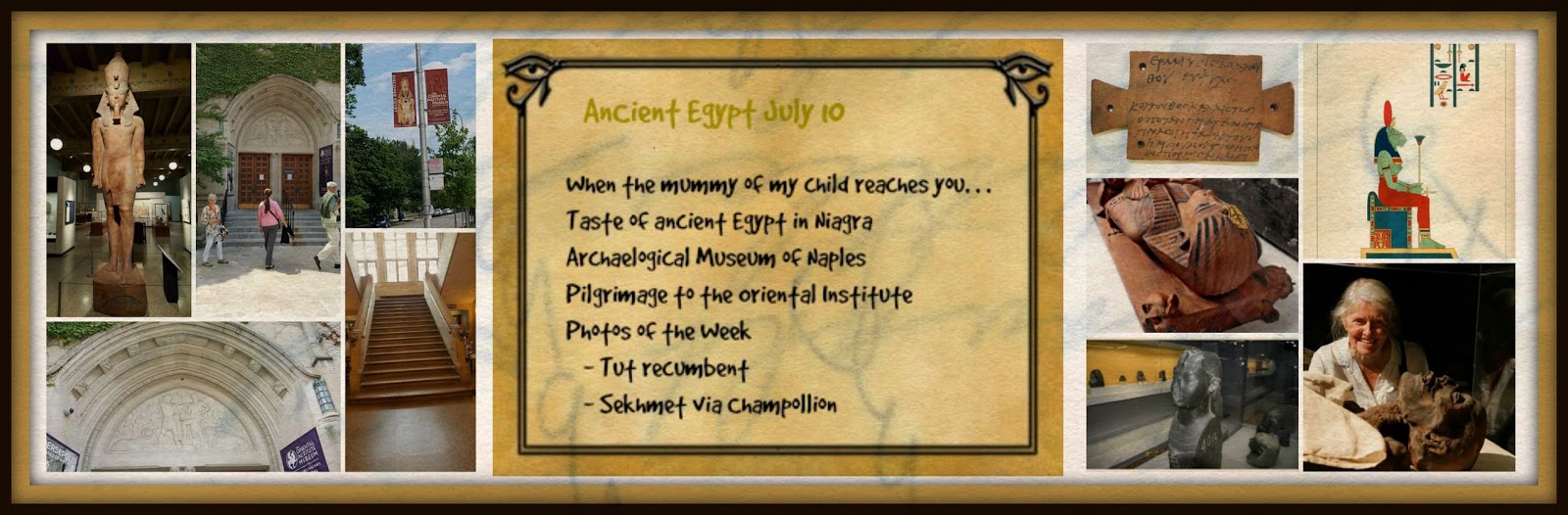
Ancient Egypt July 10


"WHEN THE MUMMY OF MY CHILD REACHES YOU, KEEP GUARD UNTIL I ARRIVE"

These are the poignant words found on a wooden label held in the Egypt Centre in Swansea. This simple tabula anisette shaped item, with its 4 holes for attachment, was placed on a mummy as an identification tag.

A taste of ancient Egypt in Niagara

NIAGARA-ON-THE-LAKE — Famous Egyptologist Gayle Gibson of the Royal Ontario Museum and Laura Ranieri of Ancient Egypt Alive are offering Niagarans a “Taste of Ancient Egypt”.

The pair will be hosting a history and travel talk from 2-4 p.m. at The Hare Wine Co., on Sunday, July 9 at Niagara-on-the-Lake. The special afternoon will celebrate Niagara’s 150 years of travel and acquisition along the Nile – with stories of early exploration, untold treasures – and the tombs, temples and wonders of this ancient land. The ‘vintage’ presentation will be paired with a Hare Wine Co. wine tasting – and will include information on Egypt tours slated for fall and winter 2017 and 2018.

Archaeological Museum of Naples showcases new brightly lit setup for its Egyptian collection

Light is the leitmotiv to the new setup in the section of the National Archaeological Museum of Naples devoted to Egyptian antiquities, which reopened to the public after a long hiatus (from 2010 [to October 2016]).


My pilgrimage to the Oriental Institute Museum

Because I was in Chicago; and, although I've been to University of Chicago many times, I've never been to the OI. Oddly enough for me I spent a lot of time in the Assyrian Empire Gallery, although I did not neglect Egypt.


The Oriental Institute Museum is a world-renowned showcase for the history, art, and archaeology of the ancient Near East. The museum displays objects recovered by Oriental Institute excavations in permanent galleries devoted to ancient Egypt, Nubia, Persia, Mesopotamia, Syria, Anatolia, and the ancient site of Megiddo, as well as rotating special exhibits.

Photos of the week

TUTANKHAMUN, recumbent upon a lion-bier

Tomb Gift of Maya (Chancellor of the Exchequer during the reign of Tutankhamun). Carter 331a. Egyptian Museum Cairo © Hans Ollermann 2015.
Carter 331a.
Burton 1051.
Howard Carter discovered 413 Shabti in the Tomb of Tutankhamun. Here you see one of them.

The the goddess Sekhmet

The Goddess Sekhmet, illustration from Egyptian Pantheon: Collection of mythological figures from ancient Egypt ' by Jean-Francois Champollion, published 1823-25